
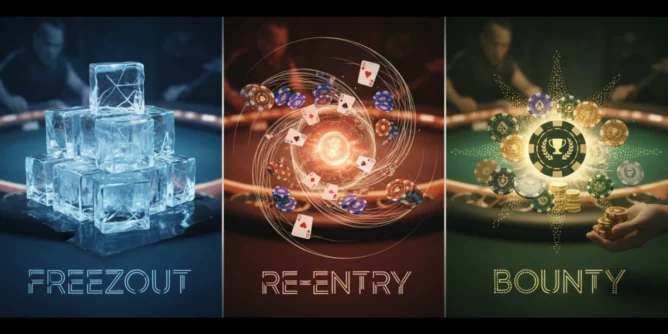
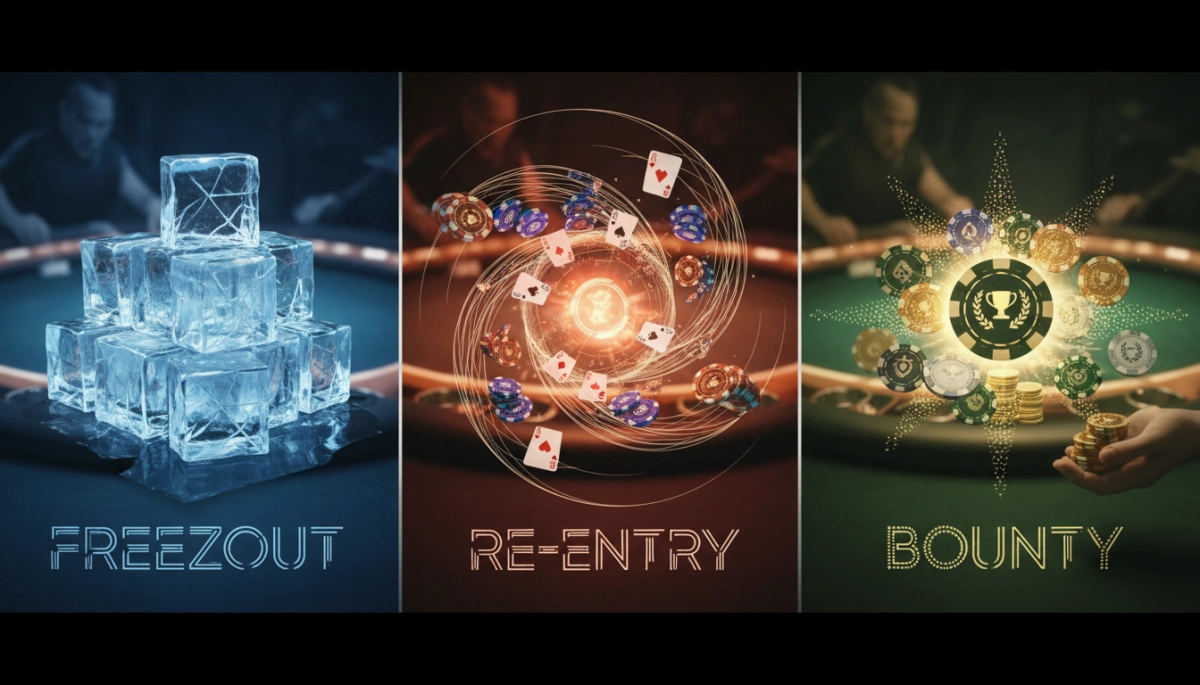
Three Formats, Three Different Games Hiding Inside the Same Tournament
Most serious players have a default MTT poker format — the one their local cardroom runs, the one they grinded online until the structure felt instinctive. The problem is that instinct trained in one format will quietly work against you in another. A freezeout specialist who drifts into a PKO without adjusting their aggression thresholds is essentially playing a different game with the wrong rulebook.
The structural differences between freezeout, re-entry, and bounty tournaments are not cosmetic. Each format applies pressure at different moments, rewards different risk tolerances, and creates distinct ICM landscapes that shift how every meaningful decision should be weighted. Understanding that distinction is not optional for players trying to compete seriously across the modern tournament circuit.
Freezeout: Where Stack Preservation and ICM Collide Most Cleanly
The freezeout is the purest form of tournament poker — one bullet, no second chances. That constraint shapes everything from the first hand. Early-stage play in a deep-stack freezeout rewards patience and speculative hand selection precisely because every chip lost has irreplaceable value. There is no rebuy absorbing the consequence of a marginal shove.
As the field narrows, ICM pressure in a freezeout becomes unusually clean to read. Each elimination moves every surviving stack up the pay ladder in a predictable, uninterrupted way. This clarity is what makes freezeouts the preferred teaching ground for ICM concepts — the math between chip EV and dollar EV is direct, without the bounty overlays or re-entry distortions that complicate other formats.
Late-stage freezeout play demands a specific kind of discipline. Near the bubble and into the money, the correct fold frequency rises sharply for medium stacks, not because aggression stops being valuable, but because the cost of elimination is immediate and final. Short stacks, by contrast, often have more push-fold freedom than players give them credit for — the ICM math can justify wider shoving ranges precisely because their tournament life has already reached a critical threshold.
Re-Entry Formats: How a Second Bullet Changes the Strategic Calculus
Re-entry tournaments look like freezeouts on the surface but function differently at almost every strategic layer. The most obvious shift is in early-stage risk tolerance. When re-entry is available, the incentive to protect your stack at all costs dissolves — players can take higher-variance lines, apply more pressure with speculative holdings, and treat marginal spots more aggressively because elimination is not the end of their tournament.
This changes the opponent pool dynamics in a measurable way. During the re-entry window, the table tends to play looser and more confrontational. Experienced players can exploit this by tightening up selectively and targeting the inflated pots that come from opponents treating the early levels as low-stakes practice. The skill edge in this phase is not about playing fast — it is about reading which opponents are genuinely loose and which are simply covering their re-entry anxiety with aggression.
Once the re-entry window closes, the strategic environment shifts abruptly. From that point forward, a re-entry tournament essentially becomes a freezeout, and players who fail to recalibrate their approach often carry early-phase aggression habits into a phase where preservation logic should be reasserting itself.
That transition point — the close of re-entry — is one of the most underexploited edges in modern MTT play. What happens to optimal strategy when a third format enters the mix, one that places an explicit monetary value on every elimination, changes the calculus entirely.
Bounty and PKO Formats: When Every Opponent Has a Price Tag
Progressive knockout tournaments introduce a variable that neither freezeouts nor re-entry formats contain — a direct, immediate financial incentive attached to every elimination. Half of each buy-in feeds the prize pool in the conventional sense, while the other half seeds a bounty that grows every time a player is knocked out. The moment you collect a bounty, your own head price increases. That single mechanic rewires strategic logic at almost every stack depth.
The most immediate consequence is what experienced PKO players call bounty equity distortion. A player who might be a clear fold target in a freezeout — short-stacked, desperate, shoved into your big blind — becomes a mathematically attractive call candidate the moment their bounty is large enough to offset the chip EV risk. The correct calling threshold genuinely widens, sometimes dramatically, and players who apply standard freezeout ranges without accounting for the bounty overlay are consistently leaking value in these spots.
Aggression Thresholds and Stack Targeting in PKO Play
Bounty formats do not simply reward aggression — they reward selective aggression directed at the right targets. Stack depth and bounty size interact in ways that create a secondary meta-game running beneath the standard chip accumulation logic. Identifying which opponents are carrying inflated bounties and engineering situations to isolate them becomes a strategic priority that has no equivalent in freezeouts or re-entry events.
This targeting instinct has downstream effects on table dynamics. Short stacks with large bounties attract disproportionate aggression from multiple directions simultaneously. This creates a specific pattern worth recognizing: when several players are hunting the same bounty, the table tends to open up in ways that allow tighter players to navigate quietly into stronger positions. The chaos of bounty pursuit can be profitable for those disciplined enough not to join the hunt indiscriminately.
Late-stage PKO play introduces another layer of complexity that many recreational players handle poorly. As the field shrinks and remaining bounties grow larger relative to the prize pool, the tension between bounty equity and ICM pressure intensifies. Near the final table, collecting a single large bounty can represent a meaningful percentage of a player’s expected value — yet the risk of elimination in pursuit of that bounty carries increasingly severe ICM consequences. Navigating that tension cleanly is what separates competent PKO players from genuinely strong ones.
How Format Structure Reshapes Late-Stage ICM Across All Three
When you map all three formats against late-stage ICM pressure, a clear hierarchy of complexity emerges. Freezeouts present the cleanest ICM environment — chip counts translate into tournament equity through a relatively direct relationship, and the pressure to survive versus accumulate chips follows predictable logic that solver outputs model well.
Re-entry tournaments complicate this picture primarily through field composition effects. Players who have re-entered once tend to carry larger stacks into the late stages, having paid more total equity to remain in contention. The late-stage field in a re-entry event is subtly different from a freezeout field at the same stage — deeper average stacks, a higher proportion of committed players, and an aggregate risk tolerance that has already been demonstrated through willingness to fire multiple bullets.
PKO formats fracture conventional ICM logic most severely. Standard ICM models assign value purely based on chip counts and payout structures, but in a PKO those models are incomplete without incorporating the bounty layer. A player sitting on an inflated bounty is simultaneously a valuable target for opponents and an entity with distorted risk-reward calculations of their own. The result is a late-stage dynamic where some traditionally dominant ICM pressures — particularly the instinct to avoid marginal all-in confrontations near pay jumps — get partially overridden by bounty arithmetic that runs on its own separate track.
- In freezeouts, survival pressure and chip accumulation exist in clean, measurable tension throughout.
- In re-entry formats, the late game rewards players who recognized the transition point and recalibrated decisively.
- In PKO formats, late-stage decisions require simultaneously solving for conventional ICM, bounty equity, and opponent targeting — three overlapping calculations that demand a more layered decision framework than any single-format specialist is likely to have developed naturally.
The practical implication is uncomfortable for players who prefer a single unified theory of tournament poker. No such theory holds cleanly across all three formats. The strategic toolkit that makes a player dangerous in one structure will, in specific and identifiable ways, create exploitable tendencies in another.
Playing the Format, Not Just the Cards
The strongest tournament players operating across the modern circuit share one underappreciated quality: they treat each format as a distinct discipline with its own internal logic, not as a variation on a single universal game. That orientation is not about memorizing different rule sets. It is about recognizing which pressures are actually live at any given moment and calibrating decisions accordingly, in real time, under conditions that reward speed and punish rigidity.
Freezeout competence is built on patience, ICM fluency, and the discipline to recognize when survival calculus genuinely overrides chip accumulation instincts. Re-entry skill is built on a different kind of awareness — reading the room during the open window, exploiting the players who never mentally close it, and then executing a clean strategic reset the moment structure demands it. PKO mastery requires holding multiple calculations simultaneously: standard equity, bounty overlay, and opponent targeting running as parallel threads rather than sequential considerations.
None of these skill sets is simply a harder version of the others. They are genuinely different in character, and treating them as interchangeable is one of the more costly and common errors recreational and intermediate players make when moving between events. The field is rarely as format-aware as it should be, and that gap is where the real edge lives.
For players serious about developing that edge systematically, engaging with structured poker strategy resources that address format-specific theory — rather than generic tournament advice — will accelerate the process considerably more than volume alone ever will.
The three formats will keep running side by side on every major circuit, online and live. The players who understand what each one is actually asking of them, and who can shift their framework cleanly as the structure demands, are the ones consistently positioned to extract value that format-blind opponents leave on the table every single tournament they enter.
