
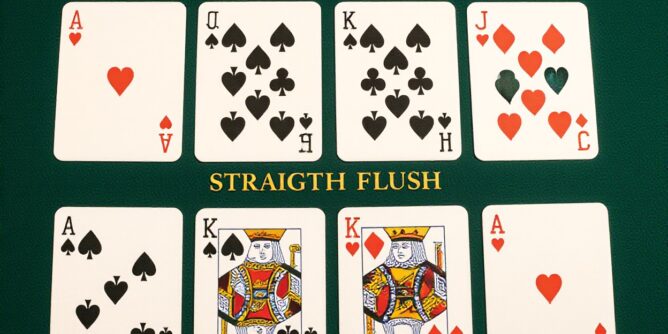
You will master poker hand rankings in this concise guide, with clear examples and tips to apply at the table; know that a Royal Flush is the unbeatable top hand, while misreading rankings can cost you valuable chips, so learn and practice each hand from straight flush to high card to improve decisions, reads, and bet sizing during play.
Understanding Poker Hand Rankings
Grasp the relative strength and frequency of hands: there are 10 standard poker ranks from High Card up to the Royal Flush. A royal flush occurs in just 4 of 2,598,960 five-card combinations (≈0.000154%), while common hands like a pair appear far more often. Knowing both the order and how often each hand appears guides value betting, folding, and bluffing decisions in every betting round.
Overview of Poker Hands
From weakest to strongest the list runs: High Card, One Pair, Two Pair, Three of a Kind, Straight, Flush, Full House, Four of a Kind, Straight Flush, and Royal Flush. For example, a full house (three of a kind plus a pair) always beats a flush, and a two pair beats a single pair. These concrete hierarchies decide showdown winners and dictate strategy.
Importance of Hand Rankings in Gameplay
Hand rankings directly shape decisions: preflop hand selection, whether to chase draws, and when to bluff. Apply them with math – pot odds and outs turn abstract ranks into correct calls or folds. For instance, pot odds of 2:1 require about 33% equity to justify a call; if your hand’s equity (based on outs and board) exceeds that, calling is often profitable.
Consider a concrete flop: K♠ Q♠ 7♦ and you hold A♠ J♠ – you have a nut flush draw with 9 outs. Hitting by the river from the flop is ≈35%, and on the turn a single-card chance is ≈19.6%. If the pot is 100 and an opponent bets 50, calling costs 50 to win 200 (required equity 25%), so your ~35% equity makes the call mathematically favorable. This ties rankings, odds, and real decisions together in practical poker play.
Types of Poker Hands
Different poker hands are grouped by frequency and strength to guide betting and hand reading. The list below simplifies the ten standard hands into five paired categories for quick decision-making.
- High Card
- Pair / Two Pair
- Three of a Kind / Full House
- Straight / Flush
- Four of a Kind / Straight Flush
| High Card | Weakest hand, wins only when no other combinations appear. |
| Pair / Two Pair | Common hands; pairs are frequent while two pairs beat single pairs. |
| Three of a Kind / Full House | Trips beat pairs; a full house combines trips plus a pair for a strong hand. |
| Straight / Flush | Straights use sequence by rank; flushes use suit – flush usually outranks a straight. |
| Four of a Kind / Straight Flush | Four of a kind is near the top; straight flush (including royal flush) is the rarest and strongest. |
High Card
When no player has a combination, the highest single card decides the pot; in poker this is the weakest outcome and often led to conservative play. High cards like an ace or king can win small pots, but they are vulnerable against any made hand.
Pairs and Two Pairs
A pair is two cards of the same rank; two pair combines two different pairs and ranks above a single pair. In poker these are common showdown hands and form the backbone of many mid-strength strategies.
Statistically, a single pair appears roughly 42% of the time by showdown in five-card draws, while two pair occurs about 4.75%-so assess board texture and opponent ranges. Strong kicker values and position often determine whether a pair can be played aggressively or folded to heavy action.
Three of a Kind and Full House
Three of a kind (trips) beats any pair and forms when you hold or hit a set; a full house pairs trips with another pair and is a very strong hand in poker. Both require reading betting patterns to extract value.
Trips can be disguised if the set comes from pocket pair, making them harder to detect and more profitable to slow-play; full houses dominate straights and flushes, winning large pots-pay attention to possible higher full houses on coordinated boards.
Straight and Flush
A straight is five sequential ranks; a flush is five cards of the same suit. In poker flushes typically outrank straights, and both are sensitive to board flush/straight completes that change hand strength quickly.
Counting outs and considering suit distributions is necessary: with four to a flush you have nine outs (~35% to hit by the river in Texas Hold’em), while open-ended straight draws offer eight outs (~31% to hit), influencing pot odds and bet sizing decisions.
Four of a Kind and Straight Flush
Four of a kind (quads) is beaten only by a straight flush, which includes the royal flush as the absolute top. Both are extremely rare in poker and usually win massive pots when concealed until late streets.
Quads often arise from pairing the board or holding a pocket pair that hits trips on the turn or river; straight flushes are so rare that when they appear they typically come from coordinated boards-protect your hand but be mindful of potential higher quads or royal possibilities.
Tips for Recognizing Hand Rankings
Compare the board to your hole cards fast: there are 2,598,960 five-card combinations, so a royal flush (4 combos) beats a pair (1,098,240 combos).
- Scan for straights/flushes first; these beat trips/sets.
- Count outs-e.g., 9 outs after four to a flush.
- Use rank counts: pocket pairs give 6 set-combinations per rank on later streets.
Assume that drilling with a 169-hand starter chart and practicing 500 hands/hour improves poker pattern speed.
Common Hand Patterns
Pairs and two-pair show up most often in showdown pots, while a pocket pair hits a set on the flop ~11.8%; suited connectors (e.g., 7♠8♠) produce more straights/flushes than offsuit equivalents. Track three patterns-made hands (top pair/sets), draws (open-ended/flush draws), and air/blockers-to prioritize decisions using the 169 starting-hand matrix in poker.
Visual Aids for Learning
Use color-coded starting-hand charts and range grids to lock visual patterns: the 169-hand matrix highlights premium (AA, KK), playable (AQs, KQs) and fold hands, while equity heat maps show relative strength across ranges in poker.
Apply tools like Equilab or PokerStove for 10,000-hand Monte Carlo sims and PioSolver for GTO ranges; print a 6-column cheat sheet for early/mid/late positions, mark a typical 15% opening range, and run daily 15-minute flashcard drills-these concrete steps convert visual charts into faster, situational ranking recall.
Step-by-Step Guide to Determining Hand Value
Quick steps and concrete examples for assessing value in poker
| Step | Example / Result |
|---|---|
| 1. Count best 5-card hand from your 7 cards | With A♠ K♠ and board A♦ 7♣ K♥ 2♠ 9♦ → best is Two Pair (Aces and Kings). |
| 2. Check for flushes | Holding A♣ K♣ and board Q♣ 7♣ 2♣ → you have an Ace-high flush, a very strong poker hand. |
| 3. Check for straights | With 5♠ 6♥ and board 7♦ 8♣ 9♣ → you have a 5-6-7-8-9 straight. |
| 4. Look for full houses / quads | Holding K♦ K♣ with board K♠ 7♦ 7♣ → you have a Full House (Kings full of Sevens). |
| 5. Assess draws vs made hands | With 9♣10♣ and board J♣ Q♦ 2♣ → you have a straight draw and a flush draw; calculate outs and pot odds. |
Analyzing Your Cards
Start by ranking your hole cards: pairs, suited connectors, and high cards matter. For example, pocket pairs (e.g., 88) win about 12% of preflop matchups against random hands; suited A-K has ~67% equity versus A-Q off when heads-up. Prioritize hands with multiple ways to improve-pairs plus flush/straight potential increase expected value in later streets.
Evaluating Community Cards
Scan the board for paired cards, three-suited boards, and connected ranks. A board like Q♠ J♠ 10♦ gives broadway and straight possibilities; if you hold K♠9♠ you’re on a made straight and a flush draw simultaneously-high risk but high reward in many pots. Count visible outs precisely before committing chips.
Also factor opponent ranges and board texture: a paired board (e.g., K♣ K♦ 5♠) reduces straight possibilities but raises full-house risk; coordinated boards (8-9-10) favor players with connected hands and increase the chance an opponent holds a made straight. Use precise outs-multiply outs by 2 for turn-to-river (~4% per out) and consider fold equity when draws are non-nut (e.g., backdoor or lower flush draws).
Factors Influencing poker Strategy
Table dynamics, stack size, blind pressure and player types force range and bet-size adjustments; for example, 100-BB stacks favor speculative plays like suited connectors, while 20 BB converts decisions to push/fold. Game format matters: full-ring tightens UTG opens to ~10% whereas 6-max widens button opens by 15-25 percentage points. Use HUD numbers and hand histories to quantify leaks. After studying showdown frequencies and aggression stats you can target specific opponents and exploit range imbalances.
- Stack size – 20 BB vs 100 BB changes calling/pushing ranges in poker.
- Blinds & antes – rising levels increase steal frequency and tighten open ranges.
- Player tendencies – 25% three-bet vs 5% three-bet requires different 4-bet thresholds.
- Position – BTN opens ~40-60% in 6-max; UTG ~10% in full-ring.
Understanding Player Behavior
Aggression and calling rates reveal style: a 40% VPIP with a 25% three-bet typically signals loose-aggressive, while a 15% VPIP and 70% fold-to-steal marks passive-tight. Use HUD stats like WTSD and W$SD to spot players who only play strong showdowns versus those who bluff frequently. In live poker, timing and physical tells add edges; online, frequency-based exploits (e.g., overfolding to 3-bets) convert into steady EV gains.
Position at the Table
Position dictates permissible ranges and bluff equity: in full-ring poker UTG open to ~10%, CO ~20-25%, BTN up to 40-60%; acting last lets you widen steals and execute multi-street bluffs. Early-position play should be value-heavy; late-position players can leverage information to thin-value and apply pressure. Winners in 6-max cash games often open-button 15 percentage points wider than breakeven opponents.
Late position converts marginal hands into profitable plays in poker: with 100 BB on the button you can raise small pairs and hands like A5s to isolate limpers. Postflop, monitor SPR-values near 2 favor commitment with top pair, while SPR >5 rewards suited connectors and deeper play. Target continuation-bet frequencies of 50-70% on dry boards when IP; versus sticky callers, cut bluffing and increase value density to protect stack equity.
Pros and Cons of Different Hands
| Pros | Cons |
|---|---|
| High pairs (JJ+): dominate many ranges, great for value-betting and isolating-pocket Aces vs random ≈85% equity. | High pairs (JJ+): vulnerable to overcards and sets on coordinated boards (e.g., A‑K‑2 or 7‑7‑7 situations). |
| Medium pairs (77-TT): good implied odds multiway; often profitable to set-mine with 100bb+ stacks. | Medium pairs (77-TT): struggle in big-bet pots postflop when faced with overcards and aggression. |
| Small pairs (22-66): hit a set on the flop ~12%, offering massive implied odds when it connects. | Small pairs (22-66): fold equity is low until you hit; ineffective in short-stack, high-blind pressure spots. |
| Suited connectors (98s, JTs): provide disguised straights/flushes and strong multiway equity when deep-stacked. | Suited connectors (98s, JTs): require implied odds and position; equity realization drops against tight, aggressive players. |
| Big Aces (AK, AQ♠): huge fold equity preflop and top-pair potential; dominates many hands when it hits. | Big Aces (AK, AQ♠): often two‑card dominated (e.g., A9 vs AK) and can lose large pots when paired with a weaker kicker. |
| High-card speculative hands: cheap to play preflop and can win large pots if boards favor you and opponents overcommit. | High-card speculative hands: high variance, low showdown value, and poor candidates for isolation or bluff-catching in modern poker. |
Strengths of Strong Hands
Top-tier holdings like pocket Aces, Kings, or AK convert to consistent profit: they win >50% of the time heads-up and allow controlled aggression with fold equity. Against a single caller these hands let you extract value on most runouts; with 100bb stacks you can size bets to maximize returns. In tournament poker they also simplify decisions-play them for value and protect equity when boards coordinate.
Weaknesses of Weak Hands
Marginal holdings (weak A‑x, low offsuit cards) lose equity fast when dominated; for example, A9o vs AK wins well under 20% preflop. They rarely command fold equity and require cheap prices or multiway pots to realize any equity, making position and stack depth decisive factors in whether to play them in poker.
Expanding on that, small pairs depend on the ~12% chance to flop a set-otherwise they have little showdown value and need implied odds to be profitable. Suited connectors need deep stacks and favorable table dynamics; against short stacks or tight opponents their expected value collapses. Adjust strategy by folding weak holdings in early position or when blind pressure and player types (aggressive raisers) make extraction unlikely.
Final Words
Now, a clear grasp of hand rankings, odds, and positional strategy elevates your poker play: knowing how straights, flushes, full houses and sets compare to pairs and high cards enables accurate betting and folding decisions, while studying examples and practicing hand reading builds the consistency needed to win over time.
FAQ
Q: What is the order of poker hand rankings from highest to lowest, with examples?
A: Highest to lowest – Royal Flush: A♠ K♠ Q♠ J♠ 10♠ (highest straight flush). Straight Flush: 9♥ 8♥ 7♥ 6♥ 5♥. Four of a Kind: K♣ K♦ K♥ K♠ 3♣. Full House: A♣ A♥ A♦ 9♣ 9♦ (three + pair). Flush: 2♠ 6♠ 9♠ J♠ K♠ (five same-suit cards, not sequential). Straight: 5♦ 6♣ 7♠ 8♥ 9♦ (five sequential ranks, mixed suits; A-2-3-4-5 is the lowest straight). Three of a Kind: Q♣ Q♦ Q♠ 5♥ 2♣. Two Pair: J♣ J♦ 4♠ 4♥ 9♦. One Pair: 10♣ 10♠ 3♦ 7♣ 2♥. High Card: K♣ J♦ 8♠ 4♥ 2♦. Use these rankings whenever you evaluate poker hands to determine the winner.
Q: How are ties resolved when players have the same type of poker hand?
A: For identical hand types, apply standard kickers and rank comparisons: Straight/straight flush – higher top card wins (10‑9‑8‑7‑6 loses to J‑10‑9‑8‑7); Four of a Kind – compare the quads, then the kicker if needed (K K K K 3 loses to A A A A 2). Full House – compare the three of a kind first, then the pair. Flush – compare highest card, then next highest, etc. Two Pair – compare highest pair, then second pair, then kicker. One Pair – compare pair rank, then kickers in descending order. Suits do not rank in standard poker. If all relevant ranks are equal, the pot is split. These tie rules apply across most poker variants unless a house rule overrides them.
Q: How do these poker hand rankings apply across common variants and special rules?
A: In Texas Hold’em the best five-card poker hand is made from any combination of the seven cards (two hole cards + five community). In Omaha you must use exactly two hole cards and three community cards to make your five-card hand – this changes which combinations are possible. Lowball (Razz) and many high‑low split games use different ranking systems (low hands win; straights and flushes may or may not count depending on the variant). Wildcards and jokers alter standard rankings by enabling atypical combinations (for example, wildcards make five‑of‑a‑kind possible and rank it above a royal flush). Always verify variant-specific rules at the table so you apply poker hand rankings correctly for that game.
