
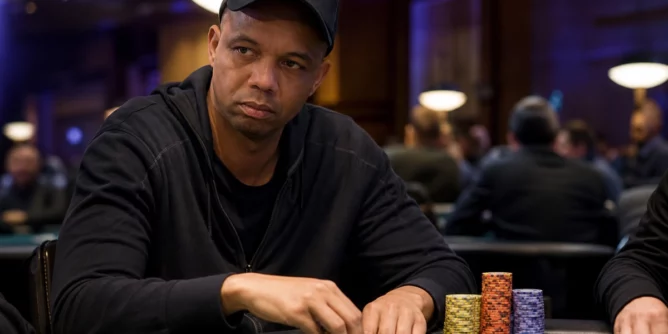
Why Phil Ivey Occupies a Category of His Own
Most poker debates about the greatest player ever eventually circle back to the same name. Not because Phil Ivey has the most tournament victories or the largest recorded win, but because the players who have sat across from him — at every stake, in every format — consistently describe the same unsettling experience: the sense that he is operating at a different frequency.
That reputation was not built on a single championship run or a televised bluff. It was constructed over decades of sustained excellence across cash games, tournaments, and mixed formats. Understanding why Ivey is different requires more than listing his accomplishments. It requires looking at the specific mechanics of how he plays, thinks, and adapts.
The Technical Foundation Beneath the Mystique
One of the easiest mistakes when analyzing Phil Ivey is attributing his edge primarily to psychological intimidation or table image. Those elements exist and matter. But the foundation is technical. His hand-reading ability — narrowing ranges under pressure and extracting maximum value from thin edges — is widely regarded among his peers as among the finest ever demonstrated at a live table.
What separates elite hand-reading from competent hand-reading is not putting someone on a specific hand. It is weighing ranges dynamically as the action develops, updating continuously based on bet sizing, timing, and physical behavior. Ivey’s documented comfort with this process, even in high-variance spots where most players freeze, reflects years of deliberate pattern recognition compressed into real-time decisions.
His aggression is calibrated rather than habitual. Weaker players confuse fearlessness with recklessness. Ivey’s pressure game is selective — deployed where range advantage and read alignment make aggression mathematically justified, not simply to force decisions. That distinction is what allows him to run sophisticated bluffs without bleeding equity over time.
Adaptability Across Formats: The Clearest Measure of True Skill
The strongest argument for Ivey’s place at the top of any serious ranking is not his performance in any single variant. It is the consistency of his results across fundamentally different formats. Texas Hold’em, Omaha, Seven-Card Stud, Razz — his ability to shift disciplines and compete at peak level speaks to something deeper than game-specific expertise.
Most great players are products of their primary format. They develop an exceptional edge in one game and leverage it through specialization. Ivey built his reputation by refusing that ceiling. His success in mixed games, particularly in the highest-stakes private cash games where format rotates frequently, demonstrates a strategic framework that transcends any single rule set — not a fixed system to execute, but a problem-solving discipline where the variables change and the principles hold.
The Psychology of Composure at Maximum Stakes
There is a specific kind of pressure that exists only at the highest stakes — where a single hand can exceed most people’s annual income and every decision is being analyzed by opponents who are themselves among the best in the world. Most players experience some measurable degradation in decision-making under that weight. Ivey is one of the few for whom that dynamic appears to reverse.
His composure is not the blank stillness of someone suppressing emotion. It is the product of a psychological architecture that treats money as a unit of measurement rather than a source of meaning. Ivey seems to become more precise, not less, as the stakes escalate — an uncommon trait even at elite levels, with material consequences at the table.
When a player is emotionally detached from monetary outcome, their decision trees remain clean. They can execute a fold on a large river bet without sunk-cost distortion. They can fire a third barrel where most would abandon the line because the pot has grown intimidating. Ivey’s ability to maintain that separation — consistently, across sessions that run for hours at extreme pressure — is one of the most underappreciated dimensions of his edge.
How He Exploits Information Others Ignore
Beyond range construction and game theory, Ivey has long been associated with an exceptional capacity for live reads — synthesizing physical behavior, timing patterns, and betting tendencies into actionable information. Live reads at his level are not about catching a single tell. They function as a supplementary data stream that helps resolve ambiguous spots where range analysis alone leaves multiple viable options. When the math produces a close decision, reliably interpreting behavioral signals earns a consistent edge that compounds across thousands of hands.
What makes this skill particularly difficult to replicate is that it requires two things simultaneously: the technical fluency to know when a spot is genuinely close, and the perceptual sensitivity to extract useful signals from behavior. Most players are strong in one area and weak in the other. The combination, operating in parallel, is rare — and one reason Ivey’s game has remained formidable in live settings even as online-trained players have closed many of the technical gaps that once separated generations.
The Role of Ego — or Rather, Its Absence
Ego is one of poker’s most reliable destroyers of talent. It produces the impulse to defend a read that has gone wrong, to escalate into losing spots to avoid appearing weak, to refuse folding to a known bluffer because the table is watching. Players driven by reputation rather than outcome make subtly worse decisions in precisely the spots that matter most.
Ivey’s documented willingness to make unpopular folds, to abandon commitment in a hand when new information demands it, and to seek out the toughest possible competition rather than accumulate results against softer fields all reflect the same underlying orientation. He measures performance against the standard of optimal play, not against how the outcome looks from the outside.
- He regularly sought the toughest cash game seats rather than protecting his results against weaker opposition.
- His mixed game excellence required sustained investment in formats where his edge was narrower, not broader.
- His composure under losing variance has been consistently noted by long-term observers as functionally different from that of comparable players.
In a game where the psychological cost of variance is real and cumulative, the ability to remain structurally sound — technically and emotionally — across extended losing periods separates players who reach greatness briefly from those who sustain it over careers.
What Sustained Excellence at the Highest Level Actually Looks Like
The careers of most elite poker players follow a recognizable arc: rapid ascent, a window of peak performance, then gradual softening as the game evolves around them. Ivey’s career has not followed that arc because his edge was never primarily positional. It was never built on exploiting a knowledge gap that time would eventually close.
What has kept him relevant across formats and decades is that the core of his game — the synthesis of technical precision, behavioral intelligence, emotional stability, and genuine indifference to ego — is not something solver outputs or training software can replicate or obsolete. The average technical baseline at high-stakes tables today is meaningfully higher than it was in the early 2000s. And yet accounts from players who have competed against him recently describe the same unsettling experience as those from twenty years ago.
That continuity is the clearest possible evidence that what Ivey does is not a product of its era. For those who study the game seriously, his career offers something more useful than a highlight reel: a model of what sustainable excellence actually requires — technical mastery that never stops updating, psychological architecture that holds under genuine pressure, and the absence of the ego structures that quietly degrade most high performers over time.
The debate over the greatest poker player will continue, as it should. But among those who have played and studied at the highest levels, a quieter consensus tends to form independent of whatever argument is being made for any other name. When the conversation turns to who you would least want to sit across from — on any given night, in any format, for any amount — the answer is almost always the same.
For a broader perspective on how Ivey’s career fits within the wider history of poker’s elite, PokerNews maintains a comprehensive record of his results and tournament history that contextualizes his longevity against the full scope of professional competition.
