
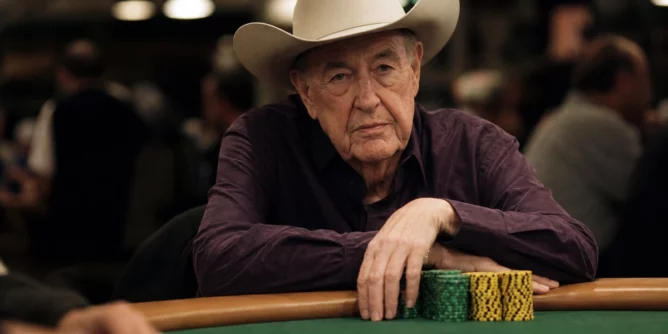
Before the Casinos: How the Road Shaped Doyle Brunson’s Game
Most players encounter poker theory in a controlled setting — a book, a training site, a structured hand history review. Doyle Brunson encountered it at gunpoint. The years he spent as a road gambler traveling through Texas and the American South in the 1950s and 60s weren’t just biographical color. They were the crucible in which his understanding of the game was forged — under conditions where misreading people had consequences far beyond losing a pot.
That experience left a permanent imprint on his approach. Pressure wasn’t something to be avoided; it was a tool. Aggression wasn’t recklessness; it was information-gathering and leverage simultaneously. These weren’t conclusions drawn from solver outputs — they were lessons extracted from environments where psychological edge was often the only edge available.
By the time Brunson arrived in Las Vegas and began competing at the highest stakes, he had already played more meaningful poker than most professionals accumulate in entire careers. The technical refinement came later. The instincts were already there.
The Shift from Survival Game to Strategic Architecture
What separated Brunson from other talented players of his generation wasn’t just results — it was the impulse to systematize. Where most high-stakes players of the era guarded their thinking closely, Brunson moved in the opposite direction. He wanted to articulate what he understood about the game, and why it worked.
That impulse produced Super/System in 1979, a book so direct about advanced strategy that several contemporaries reportedly urged him not to publish it. The concern was legitimate: it didn’t offer beginners a soft introduction. It presented a professional-level framework for No-Limit Hold’em at a time when aggressive, positionally-aware poker was genuinely foreign to most players.
The core argument — that relentless aggression combined with deep positional awareness would consistently outperform passive, reactive play — wasn’t a stylistic preference. It was a structural claim about how information asymmetry rewards the player who controls the action. Brunson wasn’t advocating wildness. He was advocating dominance through pressure, which is a meaningfully different thing.
Why Super/System Still Reads as Theory, Not History
Decades later, serious players still return to Super/System as a theoretical reference point. Some specific hand recommendations have aged poorly — solvers have refined equilibrium play and population tendencies have shifted. But the underlying logic of why aggression forces errors, why position compounds over time, and why pot control is often a myth that weak players hide behind — that logic holds.
Brunson’s influence on how the game is taught cannot be fully separated from his influence on how it is played. The two ran in parallel, reinforcing each other across decades in ways that few individual players have managed before or since.
The Players Brunson Shaped: Influence Without a Formal School
Brunson never ran a formal training program or operated a poker school. His influence moved differently — through proximity, conversation, and the osmotic process of watching someone operate at an exceptionally high level over an extended period. The players who came up around him at the Horseshoe and in the high-stakes cash games that defined Las Vegas poker through the 1980s and 90s absorbed something that couldn’t be extracted from a book alone.
What they absorbed was a disposition more than a system. Brunson’s approach demanded that a player treat every street as an opportunity to assert control rather than respond to it. That sounds simple, but execution requires a particular psychological confidence — one that doesn’t waver when large sums are at stake and the opponent is equally skilled. Watching Brunson maintain that posture across decades of high-variance situations was its own form of instruction.
Players like Chip Reese, one of the most respected cash game specialists of his generation, operated in the same orbit. The cross-pollination of ideas was constant, even when unspoken. You couldn’t sit across from Brunson regularly without interrogating your own defaults — why you checked, why you called, why you surrendered initiative when pressure might have produced a better outcome.
Aggression as a Transferable Framework
The deeper legacy of Brunson’s theoretical contribution is that it gave subsequent generations a vocabulary for something the game had largely treated as personality rather than strategy. Before Super/System reframed the conversation, aggressive play was often dismissed as recklessness. Brunson made the structural case that aggression is the more precise tool — that it generates fold equity, protects made hands, builds pots when ahead, and extracts information that passive play cannot access.
That framework traveled. It appeared in the thinking of tournament players who began dominating in the late 1990s and early 2000s as No-Limit Hold’em became the dominant format. The willingness to apply pressure with a wide range of hands, to use position as an offensive rather than defensive resource — these ideas carried Brunson’s fingerprints even when the players deploying them had never sat across a table from him.
It is worth noting what this framework does not mean. Brunson’s aggression was never disconnected from observation. His road years had given him acute sensitivity to opponents — their patterns, their tells, their emotional states. The aggression was calibrated, not automatic. Players who took the surface lesson without the underlying discipline often mistook volume for leverage, and paid for it.
The Cultural Weight of a Living Legend
There is a dimension to Brunson’s legacy that resists quantification: the symbolic function he served simply by continuing to compete. His consecutive World Series of Poker Main Event victories in 1976 and 1977 cemented a status most players could not approach on results alone. But what sustained his authority through subsequent decades wasn’t nostalgia — it was active participation at the highest levels long after he could have retired on reputation.
- Brunson competed in high-stakes cash games well into his seventies, refusing to retreat into ceremonial appearances alone.
- His presence consistently drew younger professionals who understood they were studying something that predated the modern game’s infrastructure.
- The philosophical core of his approach — that poker rewards those who force decisions rather than react to them — remained visible in his actual play, not just his written work.
This is what separates Brunson from most figures who achieve legendary status in competitive pursuits. The legend and the practitioner remained the same person for an unusually long time, giving his theoretical contributions an ongoing proof of concept that few others in the game’s history have provided.
What Endures When the Player Leaves the Table
Doyle Brunson’s legacy is not a museum piece. It lives in the behavioral defaults of players who have never read a word he wrote — in the instinct to apply pressure rather than absorb it, to treat position as something to be exploited rather than merely respected, to understand that the player who controls the action shapes the outcome more reliably than the player who waits to react.
That transmission happened across five decades through a combination of text, presence, and example that no single coaching platform has replicated. It happened because Brunson understood something about poker that precedes all technical analysis: the game is ultimately a contest of will expressed through structured decision-making, and the player with the clearer philosophy will, over time, outperform the player operating on instinct alone.
The road years gave him the instincts. The analytical discipline gave him the philosophy. Super/System gave both to everyone willing to engage with them seriously. And fifty years of active competition gave the philosophy a proof of life that no theoretical endorsement could have manufactured.
Modern poker exists in a world of solvers, game theory optimal frameworks, and training ecosystems of remarkable sophistication. And yet the questions those tools are ultimately trying to answer — when to apply pressure, how to use position as leverage, how to force opponents into uncomfortable decisions — are precisely the questions Brunson was asking out loud, in print, at a time when most practitioners preferred to keep their answers private.
That willingness to articulate, share, and continue demonstrating across a career of extraordinary length is what separates his contribution from other brilliant players who left behind only results. Results age. Frameworks compound. Brunson built something the game is still drawing interest from, and likely will be for as long as it is played seriously. For those tracing where the modern game’s intellectual foundations were laid, the World Series of Poker’s historical records offer a starting point — but Brunson’s real contribution sits deeper than any bracelet count. It sits in the way the game reasons about itself.
