
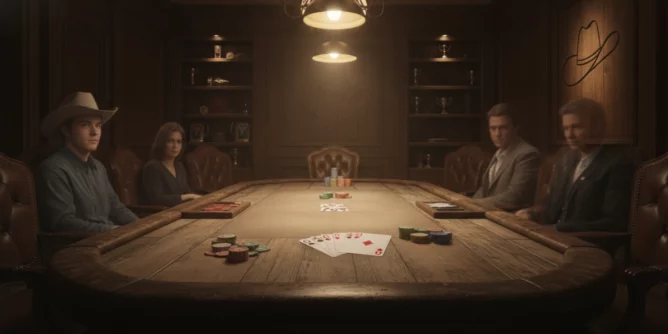
The Man Who Decided Poker Was Worth Explaining
Most players who reach the top of any competitive discipline guard their knowledge carefully. They coach selectively, share sparingly, and treat hard-won insight as a professional asset. Doyle Brunson did the opposite — and that decision alone changed the structure of poker thinking for generations.
When Super System was published in 1979, it wasn’t received as a general interest book about card games. It landed as a genuinely radical document. Brunson recruited some of the sharpest players alive — Mike Caro on draw poker, David Sklansky on limit hold’em — and assembled a text that treated poker as a serious discipline with learnable, transmissible logic. The transparency was so complete that Brunson later suggested it may have cost him money at the table. Whether or not that’s true, the gesture defined what serious poker literature could be.
That willingness to open the game up established a standard. Everything from modern training sites to solver-driven strategy discourse traces a direct line back to the idea Super System made credible: that poker rewards study, not just instinct.
Aggression as Philosophy, Not Just Tactic
Brunson’s playing style was never simply “aggressive” in the way the word gets used loosely today. It was philosophically grounded. He understood, before most contemporaries could articulate it, that aggression forces opponents into decisions and that most players make worse decisions under pressure than when given the luxury of a passive pot. The mathematical edge of being the aggressor wasn’t his invention, but he lived it more consistently than almost anyone.
His approach to no-limit hold’em — moving all-in with leverage, applying pressure before the river, treating deep stacks as weapons rather than safety nets — became the template that later generations formalized. When players today talk about range advantage, initiative, and continuation betting logic, they’re describing a framework Brunson was executing intuitively across decades of high-stakes cash games, long before the terminology existed.
The 10-2 hand is the most visible symbol of this. Winning back-to-back World Series of Poker Main Events in 1976 and 1977 with that specific holding cemented the idea that aggression and position could make any two cards dangerous in the right hands. It became his signature not because he chased it sentimentally, but because it stood for the principle underneath: the cards matter less than how you play them.
From Texas Road Gambling to the World Stage
What often gets flattened in Brunson’s biography is the distance he traveled — not geographically, but structurally. He came up in an era when poker in Texas meant illegal games, road trips between towns, and genuine physical risk. The players who survived that circuit were not merely technically skilled; they were psychologically durable in ways that structured tournament environments never quite replicate.
Brunson had played for his livelihood against dangerous opponents before the poker boom gave the game respectability. When the World Series began drawing amateur talent and eventually global television audiences, he wasn’t adapting to a new game — he was watching a game he’d mastered reframe itself around him. His aggression wasn’t recklessness refined; it was knowledge applied.
The Tournament Record as Living Argument
There’s a version of Brunson’s legacy that gets reduced to titles and bracelets, which misses what made his tournament record genuinely unusual. Winning the Main Event in consecutive years was remarkable, but the more durable statement came from his sustained presence across decades of World Series competition — deep runs and final tables long after the demographic of the field had shifted entirely around him. That consistency wasn’t nostalgia. It was proof of concept.
The poker boom of the early 2000s flooded tournament fields with opponents who had studied intensively and arrived technically prepared in ways prior generations weren’t. Conventional wisdom suggested this should have compressed the edge of older, feel-based players. Brunson’s continued competitiveness complicated that narrative usefully, forcing a more honest conversation about what poker skill actually consists of — and whether quantitative frameworks were capturing everything, or merely the most easily measurable parts.
His presence at the table carried an implicit argument: that reading accumulated information about opponents across a session, calibrating aggression to specific individuals rather than abstract ranges, and maintaining psychological equilibrium under sustained pressure were skills that didn’t expire. The players who paid closest attention to how he actually made decisions tended to come away with a more complete picture of what high-level poker demands.
What Longevity Teaches That Theory Cannot
Brunson’s career stretched across a span in which the game’s structure, vocabulary, and player pool transformed almost beyond recognition. That longevity produced a specific kind of knowledge no amount of solver work can replicate: understanding how poker changes, which elements are permanent, and which are artifacts of a particular era’s conventions.
He played against opponents who had never seen a strategy book, opponents who had read every strategy book, and opponents who had discarded strategy books in favor of software. The exploitable tendencies shifted in each period. A player who navigated all of that successfully didn’t simply have durable skills — they had a meta-level understanding of the game’s adaptability that informed every decision at the table.
This is why serious players treat Brunson’s commentary on the modern game with more weight than they might grant other voices from his era. The critique of over-reliance on solver outputs lands differently from someone who watched the game function effectively before those tools existed and can articulate precisely what they don’t capture.
The Specific Influence on How Players Think About Risk
Perhaps the most underexamined dimension of Brunson’s influence is the way his career reshaped how serious players conceptualize risk tolerance — not at the level of individual hands, but across an entire approach to the game.
Road gambling in Texas carried variance that tournament poker simply doesn’t replicate. Playing through that environment and arriving at the World Series as a dominant force meant Brunson had developed a relationship with risk not built on theoretical bankroll management, but on lived exposure to what losing actually feels like and what continuing anyway requires.
That background produces a particular composure — not the manufactured calm of someone suppressing anxiety, but the genuine steadiness of someone who has already renegotiated their relationship with uncertainty. Players who competed against Brunson frequently noted that his demeanor didn’t shift meaningfully between winning and losing sessions. It’s also a transmissible model. The players who absorbed his influence most completely tended to develop longer time horizons for evaluating results, a healthier tolerance for necessary variance, and a clearer sense of which outcomes actually mattered across a career rather than a session.
- Risk framed as information rather than threat produces better in-session decisions
- Psychological durability built through genuine exposure differs fundamentally from cultivated composure
- Career-level thinking about variance requires a reference point that only sustained high-stakes play can provide
These aren’t abstract principles lifted from a coaching framework. They’re conclusions serious students of Brunson’s career arrived at by watching how he behaved across conditions most players never encounter — and recognizing that the behavior itself was the lesson.
What Remains After the Mythology Settles
Separating Brunson’s actual influence from the accumulated mythology around him is worth the effort, because the influence is more interesting than the legend. The legend is about bracelets, about a hand called Brunson, about a Texan who came up hard and won big. The influence is about something quieter and more durable: a set of decisions — to publish, to explain, to compete honestly across half a century — that quietly restructured how serious players approach the game at every level.
The publication of Super System remains the clearest single act in that direction. Not because it contained secrets that couldn’t have been discovered elsewhere, but because the decision to write it signaled something important about what poker could be. It elevated the game’s intellectual ambition at a moment when that ambition needed a credible advocate. The players who built on that foundation — coaches, theorists, the entire online training industry — inherited a standard of transparency that Brunson established when it cost him something to do so.
His tournament longevity made a different argument, one the game’s most analytically serious participants needed to hear: that feel, accumulated context, and psychological durability weren’t skills being rendered obsolete by quantitative tools, but were occupying a dimension of the game those tools hadn’t yet learned to address. That argument is still active. The World Series of Poker continues to produce results that confound purely model-driven analysis, and Brunson’s career remains the most persuasive historical evidence for why.
What players ultimately absorb from studying him isn’t a collection of strategic techniques. It’s an orientation — toward aggression calibrated to individuals rather than theoretical ranges, toward time horizons measured in careers rather than sessions, toward the game itself as something that rewards genuine engagement rather than procedural execution. That orientation shaped how a generation of serious players think about what they’re actually doing when they sit down at a table.
The 10-2 hand will continue to be dealt, celebrated, and occasionally chased by players who understand its symbolic weight better than its strategic content. That’s fine. Mythology serves its purposes. But the more lasting hand Brunson played was the one where he decided, repeatedly and at genuine cost, that the game was worth explaining, worth competing in honestly, and worth taking seriously on its own terms. That hand holds up regardless of the cards.
