
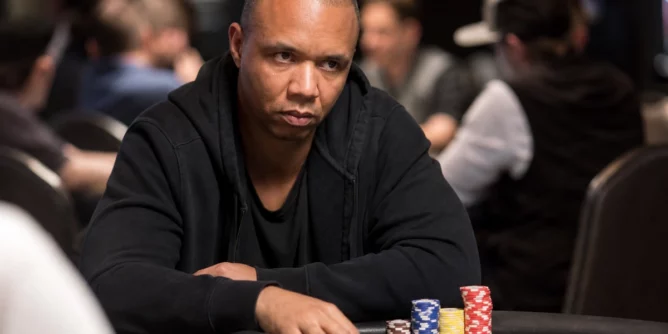
Why Phil Ivey Demands a Different Kind of Study
Most serious poker players reach a point where they stop asking who the best player is and start asking a more useful question: what can I actually learn from them? With Phil Ivey, that question gets complicated fast. He isn’t a GTO theorist, he doesn’t have a signature solver-derived range chart, and he has never positioned himself as a coach breaking down hand histories for YouTube.
What he has done is win at the highest level across more formats, more game types, and more decades than almost anyone the game has produced. That breadth is the starting point for understanding why studying Ivey requires a different frame entirely.
The contemporary poker landscape defaults toward solver-first thinking — understanding equilibrium strategies, constructing balanced ranges, minimizing exploitability. That framework has genuinely improved the game, but it also has a ceiling. Solvers optimize for a static opponent. Phil Ivey built his edge against real people, in real time, in rooms where atmosphere, history between players, and the texture of a specific moment all fed into his decisions.
The Multi-Format Edge That Defines His Reputation
What separates Ivey from legends who dominated a single discipline is the range of games he mastered at the highest stakes. World-class No-Limit Hold’em players are relatively common at the top of the game. Players who also compete seriously in Pot-Limit Omaha, Seven-Card Stud, Razz, and mixed games simultaneously — that list is far shorter.
This matters analytically, not just historically. Mastering multiple formats forces a cognitive flexibility that single-game specialists rarely develop. Each game has its own equity structures, its own rhythm of information, its own way of punishing players who apply yesterday’s mental model to today’s situation. A player who can shift between Stud Hi-Lo and PLO at the same table has learned to read the underlying logic of a game rather than memorize its surface patterns.
Ivey’s multi-game competence suggests his edge was never purely technical in the narrow sense. It was rooted in something more portable: the ability to build accurate models of opponents quickly, identify where they were vulnerable, and apply pressure in precisely those spots.
Reads, Table Dynamics, and the Intelligence Behind the Image
The word “reads” gets used loosely in poker. In Ivey’s case, it refers to something more structured than gut instinct. Players who have sat with him consistently describe the same quality: an almost uncomfortable level of attention. He watches hands he isn’t involved in, tracks bet-sizing patterns over long sessions, and notices when a player’s behavior shifts relative to their baseline.
This is applied information theory. Every hand generates data. Most players process only their own — their cards, their position, their immediate pot odds. Ivey appeared to process the table’s collective data, building a running model of each opponent that grew sharper as the session extended.
How Ivey Constructs Pressure Without Relying on Cards
One of the more instructive things about watching Ivey in high-stakes footage is how rarely his aggression seems dependent on hand strength. Ivey understood that pressure is a function of perceived credibility, not cards. And perceived credibility is built over an entire session, one decision at a time.
When he applies pressure, it lands differently than the same bet from a less established opponent because of the cumulative narrative he has constructed. He shows certain hands, folds others in ways that communicate discipline, then uses that reputation as leverage later. This is table dynamics in its most sophisticated form — not just reading opponents, but actively authoring how opponents read him.
Modern training tends to treat each hand as something close to an isolated decision tree. Ivey treated sessions as long-form conversations where early chapters determined what was possible in later ones. A well-timed fold or a transparent showdown can be as valuable as a successful bluff, because it shapes the information environment going forward.
The Relationship Between Patience and Timing
Elite poker players share a quality that is difficult to categorize but immediately recognizable: a willingness to wait longer than is comfortable before acting on an observation. Ivey has it in an unusually developed form. Players who have logged significant hours against him describe a consistent pattern — he gathers information across dozens of hands before deploying it meaningfully, and he is willing to sacrifice short-term edge to set up larger extractions later.
This runs against the grain of how most aggressive players think about maximizing expected value. The instinct for many strong players is to exploit a read the moment it becomes visible. Ivey’s approach suggests that early exploitation often forfeits the larger opportunity — a player who suspects they are being exploited will adjust, while one who has no idea keeps leaking the same spot an hour later.
Patience in his case was never passive. It was a form of information management, requiring both confidence that the opportunity would persist and a clear enough model of the opponent to recognize when the right moment arrived.
What Separates His Decision-Making from Pattern Recognition Alone
A common misreading of elite live players is to reduce their skill to pattern recognition — the idea that enough hands produces a mental database of tells that automates good decisions. That framing undersells what Ivey actually does. Pattern recognition is reactive: it identifies a signal and matches it to a previous category. What Ivey demonstrated in high-pressure spots was something more generative — the ability to build a working model of a specific opponent’s decision logic and reason forward into situations that hadn’t yet occurred. He wasn’t just recognizing weakness; he was anticipating how a player would respond to specific types of pressure applied in specific ways.
This distinction has real consequences for how players study his hands. The surface question — what did he put his opponent on? — is less interesting than the structural question: how did he arrive at that read, and what sequence of observations made it reliable enough to act on? The answers reveal a decision-making process that is:
- Built on sustained, multi-hand observation rather than single-hand signals
- Sensitive to behavioral baselines rather than absolute behaviors
- Weighted toward understanding motivation rather than simply cataloging action
- Continuously updated as new information arrives during a session
That framework applies across game types, which is precisely why Ivey’s competence traveled so effectively between formats. The cards change. The equity structures change. The underlying human beings at the table, and the ways they reveal themselves under pressure, change far less than players tend to assume.
Why His Legacy Is a Framework, Not a Formula
The temptation when studying any legend is to look for the transferable system — the checklist, the range chart, the decision tree that can be lifted and applied. Phil Ivey resists that kind of extraction, and that resistance is itself instructive. His edge was never a formula. It was a coherent approach to thinking about poker that produced results across every format he encountered seriously.
In practice, that approach looks like a set of principles: treat the session as a unit of analysis, not the hand. Build opponent models that account for motivation, not just action. Understand that your table image is a resource that can be managed and deployed. Apply pressure in proportion to the credibility you have earned, not simply the equity you hold. Wait for the moment when your read is reliable enough to justify the risk attached to it.
None of those principles require a solver. None of them are invalidated by one either. The players who study Ivey most productively tend to be those who have already developed technical competence and are looking for what technical competence alone cannot provide — the ability to operate with precision against real human beings who do not behave as equilibrium strategies suggest they should.
That gap between theory and the live table is where Phil Ivey built his career. His record across decades of high-stakes competition represents something the poker world has not fully replaced: proof that human intelligence, applied with patience and discipline to the problem of other human beings, remains one of the deepest edges the game allows.
Solvers can tell you what a balanced player would do in a given spot. They cannot tell you what the specific man across the table is about to do, or why, or which version of pressure will make him deviate from his own intentions. Ivey spent his career answering those questions in real time, at the highest stakes, across the widest range of games any player of his generation attempted. That is why serious students of poker return to him not as a historical curiosity, but as an active model — one that asks more of the student than a training application ever will, and rewards that effort accordingly.
