
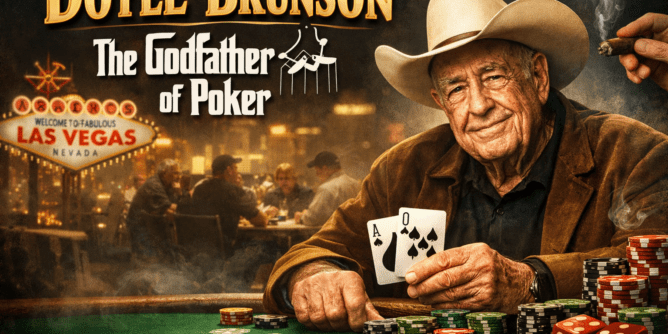
Doyle Brunson (1933–2023) wasn’t just a poker player—he was the architect of modern poker strategy, the bridge between backroom games and the global phenomenon we know today. For over five decades, “Texas Dolly” dominated the highest stakes, wrote the bible of poker strategy, and became the living legend that every aspiring player tried to emulate.
This is the complete story of the man who transformed poker from a gambling vice into a game of skill, psychology, and mathematical precision.
Early Life: From Small Town to Big Dreams
The Texas Roots
Born on August 10, 1933, in Longworth, Fisher County, Texas, Doyle grew up in a town of just 100 people. His father was a farmer and cotton gin worker who taught Doyle the value of hard work—and the importance of reading people.
Key facts:
- Population of Longworth: ~100 residents
- Nearest big city: Abilene (70 miles away)
- Family: One of three children, working-class background
Athletic Scholarship and the Knee Injury
Doyle’s first path to success wasn’t cards—it was basketball. Standing 6’3″, he earned a scholarship to Hardin-Simmons University in Abilene, where he played point guard and studied education.
The turning point: A summer job at a gypsum plant ended his athletic career. A 2,000-pound load of sheetrock crushed his right leg, shattering his knee. The injury required 18 months in a cast and ended his basketball dreams—and his path to the NBA.
“I was going to be a professional basketball player. That was my dream. When that ended, I had to find something else.” — Doyle Brunson
The Transition to Poker: 1950s Texas
Oil Fields and Underground Games
After recovering from his injury, Doyle took a job as a salesman—but his real education happened in the illegal poker games across Texas. The 1950s Texas oil boom created a perfect storm: roughnecks with cash, downtime between shifts, and a culture that loved gambling.
Doyle’s early grinding grounds:
- Fort Worth and Dallas underground rooms
- Odessa and Midland oil field camps
- Backroom games in pool halls and bars
The Dangerous Years
Texas poker in the 1950s wasn’t the glamorous casino scene of today. Doyle faced:
- Armed robberies: Games were regularly held up by criminals
- Cheating mechanics: Card sharps using marked decks and sleight of hand
- Law enforcement raids: Illegal gambling carried serious penalties
- Physical violence: Disputes were often settled with fists or worse
The famous story: In 1958, Doyle was robbed at gunpoint after winning $6,000 in a marathon session. The robbers took everything—including his wedding ring. Doyle tracked them down and got the ring back, but the money was gone.
“I was robbed more times than I can count. You learned to stay alert, trust your instincts, and always have an exit strategy.” — Doyle Brunson
The Move to Las Vegas: 1970s and the WSOP Boom
The First World Series of Poker
In 1970, Benny Binion invited the seven best poker players in the world to the Horseshoe Casino in Las Vegas for the first World Series of Poker (WSOP). Doyle was there—and he would dominate the event for the next two decades.
The original seven:
- Doyle Brunson
- Amarillo Slim Preston
- Johnny Moss
- Puggy Pearson
- Sailor Roberts
- Crandell Addington
- Carl Cannon
Back-to-Back WSOP Main Event Championships
Doyle achieved what many consider the greatest feat in tournament poker history: winning the WSOP Main Event in consecutive years.
| Year | Event | Prize | Field Size | Final Hand |
|---|---|---|---|---|
| 1976 | $10,000 No-Limit Hold’em World Championship | $230,000 | 22 entries | 10-2 suited vs A-J |
| 1977 | $10,000 No-Limit Hold’em World Championship | $340,000 | 34 entries | 10-2 suited vs A-A |
The 10-2 hand: Both victories came with the same starting hand—10-2 offsuit, the weakest playable hand in Hold’em. Doyle made a full house in 1976 (10s full of deuces) and caught a full house again in 1977 (deuces full of tens). The hand became so associated with him that “Doyle Brunson” or “the Brunson” is now poker slang for 10-2.
“I never played 10-2 again in my life—unless I was on tilt or trying to get lucky.” — Doyle Brunson
Total WSOP Success
| Statistic | Number |
|---|---|
| WSOP Bracelets | 10 |
| WSOP Cashes | 37 |
| WSOP Final Tables | 26 |
| Total WSOP Earnings | $3,038,467 |
| Main Event Cashes | 4 (1976, 1977, 1980, 1982) |
Super/System: The Poker Bible
Writing the First Comprehensive Strategy Book
In 1978, Doyle published “Super/System: A Course in Power Poker”—the first book to reveal advanced poker strategy to the public. Before Super/System, poker knowledge was closely guarded by professionals. Doyle changed everything by sharing secrets that cost him millions to learn.
The original Super/System (1978):
- Price: $100 (equivalent to ~$450 today)
- Length: 606 pages
- Chapters written by: Doyle and other legends (Mike Caro, Chip Reese, Joey Hawthorne, Bobby Baldwin)
- Games covered: Seven-Card Stud, Draw Poker, Lowball, Limit Hold’em, No-Limit Hold’em
The Impact
Super/System transformed poker from a game of intuition into a game of mathematical precision and psychological warfare. Concepts introduced:
- Aggressive play: Raising instead of calling
- Position importance: Acting last is a massive advantage
- Reading opponents: Physical and betting pattern tells
- Bluffing theory: When and why to bluff
- Game selection: Choosing profitable games over ego
“Super/System didn’t just teach people how to play poker—it taught them how to think about poker. That was the revolution.” — Mike Caro
Super/System 2 (2004)
Twenty-six years later, Doyle released “Super/System 2”, updating strategies for the modern game with contributions from:
- Daniel Negreanu
- Lyle Berman
- Johnny Chan
- Bobby Baldwin
- Mike Caro
- Jennifer Harman
- Chip Reese
- Doyle himself
The High Stakes Cash Games: “The Big Game”
Bobby’s Room at Bellagio
While tournament success made Doyle famous, his true domain was cash games. For decades, he played in the highest-stakes poker game in the world—known as “The Big Game”—initially at the Bellagio’s Bobby’s Room (later renamed “Legends Room” in his honor).
The Big Game details:
- Stakes: $400/$800 Limit Hold’em and mixed games
- Minimum buy-in: $100,000 (often $500,000+)
- Regulars: Chip Reese, Jennifer Harman, Barry Greenstein, Phil Ivey, Johnny Chan
- Duration: Games often ran 24+ hours
Legendary Cash Game Stories
The $5 million pot (estimated): In the 2000s, Doyle played a massive pot against an unnamed billionaire businessman. The businessman had four queens; Doyle had a straight flush. The pot was estimated at $5 million—one of the largest in poker history at the time.
The marathon sessions: Doyle was famous for playing 40+ hour sessions, sleeping in the casino hotel, and returning to the game. His stamina became legendary among peers.
“Doyle could play for three days straight, look fresh, and still make perfect decisions. That was his superpower.” — Jennifer Harman
Doyle’s Playing Style: The Aggressive Pioneer
Key Strategic Innovations
| Concept | Doyle’s Contribution | Modern Application |
|---|---|---|
| Aggression | First to advocate raising over calling | Standard in all modern play |
| Position awareness | Emphasized button and late position | Fundamental to GTO strategy |
| Reading hands | Developed systematic hand-reading | Basis for all poker solvers |
| Game selection | “Play the player, not the cards” | Bum hunting and table selection |
| Bankroll management | Never risk your entire roll | Essential for professional play |
The Doyle Brunson Quote Book
Doyle’s wisdom became legendary through memorable quotes:
“The key to No-Limit Hold’em is to put a man to a decision for all his chips.”
“Poker is a game of people. It’s not the hand I hold, it’s the people I play with.”
“If you can’t spot the sucker in your first half hour at the table, then you are the sucker.”
“A man with money is no match against a man on a mission.”
“The beautiful thing about poker is that everybody thinks they can play.”
The Brunson Family: Poker Dynasty
Louise Brunson: The Matriarch
Doyle married Louise Brunson in 1962, and she became his partner in every sense. While Doyle played, Louise managed their business interests, raised their children, and provided the stability that allowed Doyle to pursue his career.
The Louise story: In 1998, Louise entered the $1,000 Ladies Event at WSOP—her first and only poker tournament. She won it, earning $158,000 and a bracelet. Doyle had to borrow money to buy her into the tournament.
“I taught her everything I know. She taught me everything else.” — Doyle Brunson
Todd Brunson: Following the Legend
Todd Brunson (born 1969) became a professional poker player, winning a WSOP bracelet in 2005 in Omaha Hi-Lo. The Brunsons became the first father-son duo to win WSOP bracelets—a record that stood for years.
Todd’s achievements:
- 1 WSOP Bracelet (2005)
- 32 WSOP Cashes
- High stakes cash game regular
- Author of “Online Poker” chapter in Super/System 2
Pamela Brunson
Doyle’s daughter Pamela also played poker professionally, though less publicly than Todd. The Brunson family represented poker’s first true dynasty.
Online Poker and the Modern Era
DoylesRoom: The Online Venture
In 2004, Doyle launched DoylesRoom, an online poker site bearing his name. The site targeted American players and leveraged Doyle’s reputation to attract customers.
History of DoylesRoom:
- 2004: Launch
- 2006: UIGEA passage forced withdrawal from US market temporarily
- 2008: Re-entry to US market (legally contested)
- 2011: Black Friday shutdown
- 2011: Acquisition by Americas Card Room (ACR)
Doyle remained a spokesperson for various online sites throughout his later years, though he primarily played live cash games.
Later Years: The Legend’s Final Chapter
Retirement and Unretirement
Doyle officially “retired” from tournament poker multiple times—only to return. His love for the game was insatiable. Even in his 80s, he played high-stakes cash games regularly.
2018 WSOP: At age 85, Doyle played the WSOP Main Event, busting on Day 2. The standing ovation he received when entering the Amazon Room demonstrated the respect he commanded.
Health Battles
Doyle faced numerous health challenges in his final years:
- Cancer diagnosis (multiple occasions)
- Heart surgery
- Mobility issues requiring wheelchair for long distances
Despite this, he continued playing poker until weeks before his death.
Death and Legacy
Doyle Brunson passed away on May 14, 2023, at age 89. The poker world mourned the loss of its greatest ambassador. Tributes poured in from every corner of the poker community:
“Doyle was poker. He was the game itself. Without him, none of us would be here.” — Daniel Negreanu
“The Godfather is gone, but his legacy will live forever in every hand of poker ever played.” — Phil Hellmuth
“Doyle didn’t just play poker—he defined it, shaped it, and gave it to the world.” — Erik Seidel
Doyle Brunson by the Numbers
| Category | Statistic |
|---|---|
| Born | August 10, 1933 |
| Died | May 14, 2023 (age 89) |
| WSOP Bracelets | 10 |
| WSOP Cashes | 37 |
| WSOP Final Tables | 26 |
| WPT Titles | 1 |
| WPT Final Tables | 3 |
| Total Live Tournament Earnings | $6,100,000+ |
| Estimated Cash Game Winnings | $50,000,000+ (unconfirmed) |
| Years as Professional | 60+ |
| Books Authored | 5+ |
| Poker Hall of Fame | Inducted 1988 |
The Doyle Brunson Award and Honors
Recognition During His Lifetime
- 1988: Poker Hall of Fame (inaugural class)
- 2006: Named “Most Influential Force in the World of Poker” by Bluff Magazine
- 2018: Legends Room at Bellagio renamed in his honor
- Multiple “Lifetime Achievement Awards” from poker media
Posthumous Honors
- 2023: Memorial tournaments held worldwide
- 2024: Doyle Brunson Cup established (high-stakes invitational)
- Ongoing: “Brunson 10” hand permanently memorialized in poker culture
Lessons from Doyle Brunson for Modern Players
What Today’s Players Can Learn
- Adaptability: Doyle evolved from 1950s road gambler to online poker icon over 60 years.
- Game selection: He always sought weaker opponents, even at the highest stakes.
- Bankroll discipline: Doyle never went broke despite playing massive games.
- Respect for opponents: He treated everyone with dignity, from beginners to billionaires.
- Love for the game: Doyle played because he loved poker, not just for money.
“The only way to become a great poker player is to love the game. If you love it, you’ll study it, you’ll play it, you’ll live it. That’s what I did.” — Doyle Brunson
Conclusion: The Enduring Legacy
Doyle Brunson didn’t just play poker—he created the framework for how the game is understood, taught, and played today. From the dangerous backrooms of 1950s Texas to the glamorous casinos of Las Vegas, from the first WSOP to the online poker boom, Doyle was there, shaping every evolution.
His Super/System remains the most important poker book ever written. His 10 WSOP bracelets set a standard that stood for decades. His cash game dominance proved that poker was a skill game, not just gambling.
But beyond the numbers, Doyle Brunson represented something rare: integrity, class, and an unconditional love for the game. Every time someone sits at a poker table, studies a strategy book, or dreams of playing for millions—they’re walking a path that Doyle Brunson built.
The Godfather of Poker is gone, but his game lives forever.
FAQ: Doyle Brunson
Why is Doyle Brunson called “Texas Dolly”?
The nickname came from a mispronunciation. A journalist intended to write “Texas Doyle” but typed “Texas Dolly.” The name stuck, though Doyle preferred “The Godfather of Poker.”
What is Doyle Brunson’s net worth?
Estimates ranged from $75 million to $150 million at his peak, though Doyle never confirmed figures. His cash game winnings alone were rumored to exceed $50 million.
Did Doyle Brunson really win with 10-2 twice?
Yes. Both the 1976 and 1977 WSOP Main Events were won with 10-2 offsuit, making it the most famous hand in poker history.
Was Doyle Brunson the best poker player ever?
Subject to debate. Many consider him the most influential player ever. In terms of pure skill, modern players like Phil Ivey or Fedor Holz might surpass him—but no one shaped the game like Doyle.
Did Doyle play online poker?
Yes, though primarily for promotional purposes in his later years. His true passion was live cash games.
What happened to DoylesRoom?
The site was acquired by Americas Card Room (ACR) in 2011 after Black Friday. Doyle later became a spokesperson for ACR.
Is Super/System still relevant?
The fundamental concepts remain valid, but specific strategies are outdated. Modern GTO solvers have replaced many of Doyle’s tactical recommendations.
Who is the current “Doyle Brunson” of poker?
No single player has achieved Doyle’s combination of skill, longevity, influence, and cultural impact. Daniel Negreanu and Phil Ivey come closest in different ways.
