
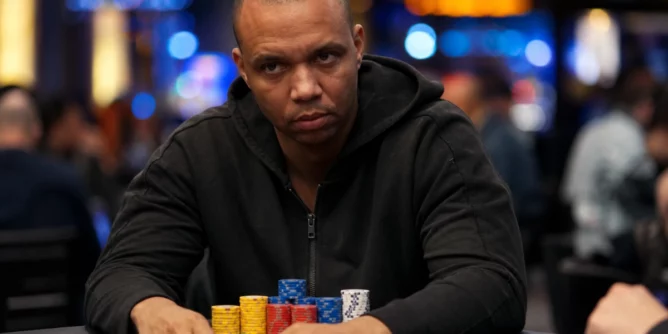
The Standard Every Serious Player Eventually Measures Themselves Against
At some point in a poker player’s development, the question stops being “how do I beat my current game?” and starts being “what does the ceiling actually look like?” For most serious students of the game, that question leads to the same place. Phil Ivey is not simply regarded as a great player — he is consistently identified, by peers and analysts alike, as the most complete poker player who has ever competed at the highest level.
That designation carries real weight. The modern high-stakes environment demands technical precision, deep psychological intelligence, and the ability to adapt across formats most players never seriously study. Ivey doesn’t just meet those requirements — he has redefined what meeting them looks like.
Why Cross-Format Mastery Changes the Conversation
The argument for Ivey’s singular status rests on something that separates him from almost every other player in the conversation: he doesn’t just dominate one format. His record spans No-Limit Hold’em, Pot-Limit Omaha, Seven-Card Stud, Razz, and the full suite of mixed games — disciplines that require fundamentally different strategic frameworks, not just slight adjustments to the same mental model.
Most elite players build their reputation within a single game type, then occasionally venture outside it. Ivey did the opposite, treating mixed games not as a novelty but as the purest expression of poker skill. His WSOP bracelets reflect that breadth directly — won across a range of disciplines, not concentrated in one event type.
This matters because mixed games expose weaknesses that No-Limit Hold’em conceals. A player who survives on aggression and reads alone will get ground down in structures demanding hand-reading precision, positional discipline, and patience in fixed-limit environments where the margin for error is distributed differently. Ivey’s consistency across those conditions is what separates his record from players with comparable results in a single format.
What Analysts and Peers Consistently Identify as the Core Separators
When serious analysts and top professionals attempt to isolate what makes Ivey different, a few qualities surface repeatedly. The first is his information processing speed — not just reading physical tells or timing patterns, but synthesizing hand history, opponent tendencies, table dynamic, and range distributions simultaneously, under pressure, in real time.
The second is competitive neutrality. Ivey plays the same way in a televised cash game as he does in a $10,000 tournament. There’s no observable shift in focus when the money gets bigger. That emotional flatness, far from being passivity, is a form of discipline most players spend years trying to develop and never fully achieve.
The Strategic Mechanics Behind His Cross-Format Dominance
What makes Ivey’s multi-format excellence unusual isn’t just breadth — it’s depth. In No-Limit Hold’em, his edge emerges from range construction. He thinks in terms of entire range distributions rather than isolated hand strength, meaning his betting patterns carry strategic coherence across a session rather than just within individual hands. Opponents trying to build a counter-strategy find themselves chasing a moving target, because his lines are designed to be internally consistent across many situations rather than exploitative in any one spot.
In fixed-limit formats, where all-in pressure doesn’t exist, the game becomes granular — small edges compounding over hundreds of decisions. This environment punishes players who rely on aggression as a primary tool. Here, Ivey’s patience becomes his weapon. His understanding of equity in marginal situations, his willingness to release hands with surface-level value but negative expected value in context, and his attention to the long arc of a session make him consistently difficult to exploit over any meaningful sample.
Adaptability as Deliberate Practice
There’s a tendency to attribute elite performance to innate talent, which understates the deliberate work behind it. Ivey’s adaptability across formats reflects a specific orientation he has maintained throughout his career: treating every format as a serious area of study rather than a secondary pursuit.
This shows up in how he approaches unfamiliar opponents. Rather than defaulting to a fixed game plan, Ivey starts from observation and constructs his strategy from what he actually sees, updating continuously as the session develops. Players who have competed against him frequently note how quickly he identifies the exploitative angle specific to that opponent — not a general style, but the precise leak that belongs to that individual at that table on that day.
The result is that Ivey rarely plays a predictable strategic role. He can apply sustained aggression when the dynamic rewards it, shift to a trapping style when opponents will donate their stack without pressure, or play a mechanically patient game when the structure demands it. That range — and the accuracy with which he selects between modes — is what separates genuine adaptability from the surface-level version most players develop.
The Psychological Dimension Most Analyses Underestimate
Competitive neutrality deserves more analytical attention than it typically receives. It usually gets framed as temperament — a fortunate absence of nerves. That framing misses what’s actually happening.
What Ivey demonstrates is better understood as active process control. The absence of observable emotional variance isn’t passivity — it’s the result of keeping attention anchored to the decision in front of him rather than its consequence. Most players experience a measurable shift in decision quality when stakes escalate sharply. The pressure of significance leaks into the process, narrowing the options they seriously consider or pushing them toward decisions that feel safe rather than correct.
Ivey’s consistency across stakes suggests he has solved that problem more completely than almost anyone else at the same level. His decisions in a $500,000 pot show the same structural characteristics as in a fraction of that amount — the same range of options considered, the same comfort with unconventional lines, the same willingness to act on incomplete information without hedging into a suboptimal default.
- He treats each decision as a process problem rather than a consequence problem, keeping attention on inputs rather than outcomes.
- His consistency across stake levels suggests genuine internalization of expected-value thinking rather than surface-level commitment to it.
- The absence of visible tilt forces opponents to generate their own psychological narrative rather than reading his — which itself becomes a strategic advantage.
That last point is underappreciated. When a player gives off no readable emotional signal, opponents fill that vacuum with assumptions — typically self-referential ones, projecting their own fear or confidence onto a situation where it doesn’t apply. Ivey doesn’t just maintain his own discipline; he systematically degrades the quality of information his opponents are working from.
What His Career Actually Demonstrates About Elite Poker Thinking
The accumulated evidence of Ivey’s career points toward something more instructive than a list of results. It points toward a coherent model of how elite poker thinking actually functions. It starts with information: gathering more of it, processing it faster, and weighting it more accurately than the opposition. It continues with adaptability — not the shallow version that means adjusting bet sizes, but the structural kind that means reconstructing your entire strategic approach when the format or opponent demands it. And it rests on a psychological foundation stable enough that none of the preceding work gets degraded when pressure rises.
What makes Ivey’s version distinctive is how completely those three elements are integrated. A technically rigorous player might build accurate ranges and still tighten visibly under pressure. A psychologically composed player might handle escalation cleanly but operate from a fixed strategic identity that competent opponents eventually map. Ivey’s career suggests he has developed all three elements to a level where they reinforce each other rather than trade off — and that integration is what careful observers point to when they describe him as the most complete player the game has produced.
His results aren’t a collection of individual peaks — they are the cumulative output of a system functioning at elite level across decades, formats, and competitive environments that have changed substantially around him. Other players have had better individual runs. No player has sustained that quality of output across a comparable range of conditions.
The broader poker world has spent considerable time debating where Ivey ranks relative to the generation of solver-trained professionals who have reshaped the game’s technical landscape. It is a legitimate question, and one that leading poker strategy analysts continue to examine with genuine rigor. What that debate rarely disputes is the baseline: that his career represents the clearest existing example of what poker excellence looks like when it operates without a visible ceiling. Whatever the final historical accounting turns out to be, that is a useful thing to have in the game’s record.
