
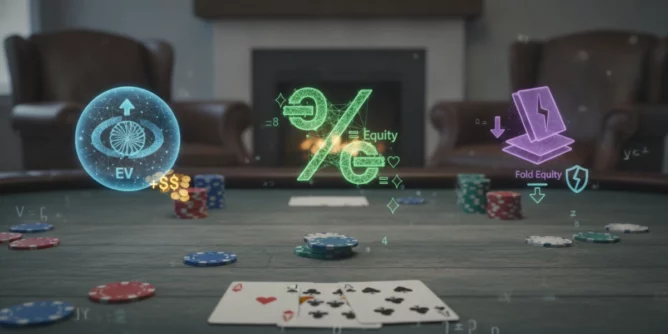
Why Poker Math Is the Foundation of Every Serious Decision
Most players who struggle at mid-stakes aren’t missing reads or table feel — they’re missing a reliable framework for evaluating decisions under uncertainty. Poker is a game of incomplete information and repeated choices. Players who win consistently have internalized mathematical tools that let them assign value to each decision rather than feel their way through it.
This isn’t about turning poker into a spreadsheet exercise. Whether it’s a cash game spot where folding the river feels uncomfortable but the math is clear, or an MTT bubble where ICM pressure reshapes every calculation, the underlying principles stay the same. Understanding poker math at this level — not just the formulas, but how the concepts interact — separates players who run well from players who run well and understand why.
Expected Value: The Single Number That Frames Every Decision
Expected value (EV) is the average outcome of a decision repeated across many iterations. It answers one question: if this situation played out a thousand times, would this choice make money or lose it? Every call, raise, fold, and bluff has an EV, and the goal is to consistently choose the highest-EV option available.
The calculation is straightforward. EV equals the probability of winning multiplied by the amount won, minus the probability of losing multiplied by the amount lost. What makes it difficult in practice is estimating those probabilities accurately — which requires a working sense of hand ranges, board texture, and opponent tendencies. The formula is simple. The inputs require judgment.
In cash games, EV is the dominant metric because no tournament structure distorts outcomes. In MTTs, raw EV interacts with stack preservation and ICM considerations, which can make the mathematically profitable play the strategically wrong one near a bubble or final table. Players who think only in chip EV often make costly errors in tournament poker.
Equity vs. Pot Odds: Understanding What You’re Comparing
Equity is your share of the pot if the hand runs to showdown across all possible outcomes. A flush draw on the flop carries roughly 35% equity against a made hand. That number alone doesn’t tell you whether to call a bet — that’s where pot odds come in.
Pot odds express the price you’re being offered on a call. If the pot is 100 and your opponent bets 50, you’re calling 50 to win 150, giving you pot odds of 25%. If your equity exceeds that threshold, calling has positive expected value. If it doesn’t, you’re paying too much relative to how often you’ll win.
The interaction becomes more complex when implied odds enter the picture. Implied odds account for additional chips you expect to win on future streets when you hit your hand, effectively lowering the price of a speculative call. Estimating them accurately requires reading whether your opponent will pay off a bet on the river or shut down when the board changes. That judgment is where poker math meets poker instinct.
Fold Equity: The Math Behind Aggression
Equity calculations assume the hand goes to showdown, but most hands don’t. That gap is where fold equity lives. Fold equity is the additional value a bet or raise generates from the probability that your opponent folds — value unrelated to the strength of your own hand. Hands that look like clear losers at showdown can become profitable plays simply because aggression forces a fold often enough.
The concept is especially important for semi-bluffs. A flush draw on a paired board might have 30% equity if called to showdown. But if a bet folds out your opponent 40% of the time, you’re winning outright nearly half the time through fold equity alone, with showdown equity covering much of the rest. The combined EV of those two paths often makes the aggressive line substantially better than the passive one.
Calculating fold equity requires estimating your opponent’s folding frequency based on their range, the board, and their tendencies. A tight opponent folds more, increasing fold equity. A calling station reduces it to near zero, which fundamentally changes whether a semi-bluff makes sense. This is why the same hand on the same board can justify two completely different lines depending on who’s sitting across from you.
How These Concepts Stack in Real Hands
The real test isn’t understanding each concept in isolation — it’s applying them simultaneously. Consider a common tournament hand: you’re on the flop with an open-ended straight draw, facing a pot-sized bet with 30 big blinds behind. Your equity against top pair sits around 32%. The pot odds require roughly 33% equity to break even on a pure call. On those numbers alone, calling is marginally losing.
But fold equity changes the picture. A raise forces opponents to fold weaker top-pair hands that don’t want to play for stacks, generating immediate EV. When called, you retain the ability to apply pressure on favorable turn cards. In an MTT context, the raise also puts your opponent in an ICM-pressured spot if stack sizes are meaningful relative to approaching pay jumps. The raise synthesizes equity, pot odds, and fold equity into one action with substantially higher EV than a passive call.
This multi-layered thinking distinguishes players who have genuinely absorbed poker math from those who use it selectively. The tools interact — sometimes reinforcing the same conclusion, sometimes pulling in opposite directions — and learning to weigh them together in real time is what makes the difference at a real table.
Stack Depth and How It Reshapes Every Calculation
Stack depth — how deep effective stacks are relative to the pot — reshapes the entire architecture of a hand’s EV calculation, not just implied odds in the obvious way.
Deep-stacked play amplifies the value of drawing hands because the potential payout when you connect is much larger. A set on the flop is worth more with 200 big blinds behind than with 30, because additional streets allow deeper value extraction. Conversely, hands with strong immediate equity but poor drawing potential lose relative value in deep-stack environments where continued pressure is likely.
In short-stack situations — typically under 25 to 30 big blinds in tournament play — fold equity becomes more polarized. The math collapses into a simpler framework: your equity if called, the pot odds you’re laying or receiving, and a stark read on how often you’ll take the pot uncontested. Players who bring a deep-stack mindset into short-stack spots are solving the wrong equation for the situation in front of them.
Making the Math Automatic: Where Calculation Becomes Instinct
There’s a ceiling to how much conscious calculation a player can perform under time pressure. The goal is to internalize these frameworks so thoroughly that they stop feeling like math and start feeling like intuition — because at that level, they effectively are. Players who consistently make correct decisions under pressure aren’t running through formulas in real time. They’ve processed enough hands and stress-tested enough edge cases that the right answer surfaces quickly from pattern recognition built on a mathematical foundation.
That process takes deliberate work away from the table. Reviewing hands through an equity calculator, running fold equity scenarios in study sessions, and pressure-testing close spots against solver outputs all build that fluency. PokerStrategy offers structured resources for players developing this systematic approach, covering fundamental equity concepts through advanced tournament ICM frameworks.
Poker math isn’t a tool you reach for when a hand feels complicated. It’s the constant operating system behind every decision, running beneath the surface whether you’re aware of it or not. Players who haven’t built that foundation are still making decisions — just with a broken compass. Players who have it can trust their reads, adjust their lines, and tolerate variance with the confidence that their decisions are structurally sound over time.
Expected value, pot odds, equity, fold equity, stack depth — none of these concepts is difficult to grasp in isolation. What requires genuine discipline is refusing to leave any of them behind when the table gets complicated, the spot is unfamiliar, or emotion wants to override logic. The math doesn’t shift under pressure. That’s precisely what makes it worth trusting.
