
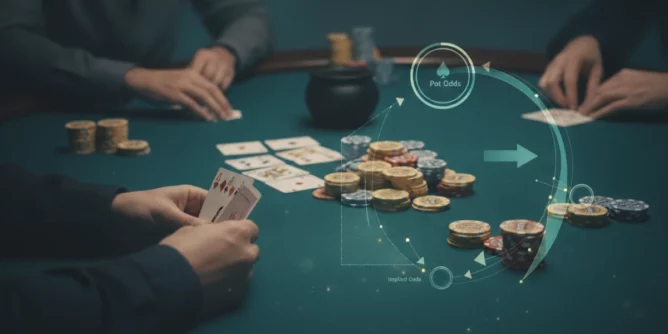
The Math Behind Calling: Why Pot Odds Are the Starting Point, Not the Full Answer
Every serious poker player reaches a point where intuition stops being enough. The bet is in front of you, the clock is running, and the question isn’t whether the hand feels right — it’s whether calling is mathematically justified. That’s where pot odds enter, not as a theoretical concept, but as a real-time decision tool.
Pot odds represent the ratio between the current pot size and the cost of the call. If there’s $150 in the pot and the opponent bets $50, the total pot becomes $200 and the call costs $50 — producing pot odds of 4:1, or 20%. That 20% is the break-even threshold. Win more than 20% of the time by the river and calling is mathematically sound.
The percentage conversion is what makes this usable under pressure. Divide the call amount by the total pot after calling. Practice it enough and it becomes automatic.
Converting Outs to Equity: The 2/4 Rule in Practice
Pot odds only become actionable when paired with hand equity. The fastest in-game method is the rule of 2 and 4. On the flop with two cards to come, multiply your outs by 4. On the turn with one card remaining, multiply by 2.
A flush draw with nine outs on the flop produces roughly 36% equity. The same draw on the turn yields approximately 18%. These aren’t exact figures, but the margin of error is small enough that decisions made on this basis are strategically sound. When pot odds require 25% equity and the hand has 36%, the call is clear. When they’re inverted, folding is correct — regardless of how the hand feels.
Poker rewards players who calculate quickly and accurately enough, not those who freeze chasing perfect numbers. A working approximation executed in three seconds beats an exact calculation completed too late to matter.
Where Implied Odds Begin: Extending the Calculation Beyond the Current Street
Pot odds measure what the pot offers right now. Implied odds account for what it might offer by the end of the hand — how much additional money can reasonably be won if the draw completes and the opponent pays it off.
A hand that doesn’t justify a call on pot odds alone can become profitable when implied odds are factored in, provided certain conditions are met: the opponent has sufficient chips remaining, they’re likely to continue on future streets, and the completed draw won’t be obvious enough to kill the action.
Stack depth is the first filter. Deep-stacked poker creates conditions where implied odds carry real weight. Shallower stacks compress the future betting that makes implied odds meaningful, which is why drawing hands lose value significantly as effective stack sizes shrink.
Quantifying Implied Odds: Turning a Concept Into a Number
Most players understand implied odds conceptually. Fewer actually put a number to it — which is where the concept transforms from a vague justification into a genuine calculation.
Start from the equity deficit. If pot odds require 25% equity and the draw only has 18%, the hand runs a 7-point deficit. That gap must be closed by future winnings. If calling costs $60 into a $180 pot and the draw hits roughly one in five times, the hand needs to win back significantly more than $60 on those occasions to cover losses from the four times it misses. Running that math doesn’t require dollar-level precision — it requires an honest assessment of whether stack sizes and opponent behavior make that payoff realistic.
Opponent Tendencies as a Multiplier
The quality of implied odds is inseparable from who is sitting across the table. Against a calling station who pays off strong hands regardless of board texture, implied odds are at their highest. Against a disciplined player who reads completed draws and folds when the third flush card arrives, they compress substantially.
Opponent profiling isn’t a soft skill that sits beside the math — it’s an input into the math. A realistic model must account for:
- Whether the opponent bets into completed draws or slows down when the board changes
- How frequently they call large river bets versus folding under pressure
- Whether their range includes hands that remain committed after draw completion
- How aware they are of draw-heavy textures and whether they adjust accordingly
Against a player who fits the first profile, implied odds are generous. Against the second, the calculation needs significant discounting — sometimes enough to turn a playable draw into a clear fold.
Draw Visibility and the Hidden Cost of Obvious Draws
There’s a dimension to implied odds that even intermediate players underweight: how readable the completed draw is to the opponent. Not all draws generate equal action when they hit.
A four-flush announces itself the moment the third suited card lands. Any attentive opponent will recalibrate — checking back the turn, reducing river sizing, or folding entirely to aggression. The future payoff the implied odds calculation depended on evaporates. A backdoor straight completing on a paired board is a fundamentally different proposition.
Nut draws present a similar tension. The ace-high flush draw carries strong raw equity, but sophisticated opponents know that a caller who suddenly bets after the third suit arrives is telling a clear story. The very strength of the draw can make it harder to extract value once it completes.
Less visible draws — gutshots that complete without altering board texture, sets on dry boards, quiet backdoor combinations — often generate better implied odds in practice than higher-equity draws that telegraph their arrival. The calculation must weigh not just the probability of completing, but the probability of getting paid upon completion. These are related numbers, but they are not the same number.
Stack Depth as the Final Variable: When the Math Changes Shape
Pot odds are essentially static — they reflect the current moment. Implied odds are dynamic — they depend on what remains to be bet. Stack depth functions as the structural ceiling on implied odds, and the same draw in the same spot can warrant completely different decisions depending on how deep the effective stacks run.
In a deep-stack cash game with 200 big blinds behind, a thin flop call can be justified by a realistic projection of two more streets of significant betting. In a tournament with effective stacks at 30 big blinds, that same draw loses most of its implied value — not because the draw changed, but because the future betting that implied odds depend on simply doesn’t exist. The calculation must reflect actual money that can move, not a theoretical maximum.
Drawing hands are deep-stack hands. The further a hand is from the nuts, the more it depends on future streets to manufacture profit, and the more sensitive it becomes to shrinking stack depth. A flush draw with no pair and no backdoor equity is an instrument whose profitability scales directly with money remaining behind.
Putting It Together at the Table: The Decision as a Unified Calculation
The gap between players who understand pot odds and players who use them well comes down to integration. Pot odds, implied odds, draw visibility, stack depth, and opponent tendencies aren’t five separate concepts — they’re inputs into a single judgment that needs to arrive quickly and hold up under pressure.
The most practical approach is to establish a hierarchy. Start with pot odds: what equity does this call require to break even? Move immediately to hand equity: does the draw have it? If yes, the call is justified on pure pot odds and everything else is secondary. If no, shift to implied odds: how large is the deficit, and how realistic is it that future streets close the gap? That assessment runs through a filter of stack depth, opponent profile, and draw visibility before arriving at a number that honestly represents the implied value of continuing.
Where players most often go wrong is letting implied odds become a rationalization rather than a calculation. A draw four points short on equity, against a tight-aggressive opponent who folds the river to any flush-completing bet, with 25 big blinds behind, is not a profitable call. Recognizing that honestly, in the moment, is what separates disciplined mathematical thinking from wishful thinking dressed in the language of math.
For players looking to sharpen this process, resources like PokerNews Strategy offer worked hand examples illustrating how professional players integrate these calculations into real decisions — one of the most effective ways to internalize the framework rather than merely understand it in the abstract.
Making Peace With Uncertainty, Not With Imprecision
There is an irreducible uncertainty in every drawing decision. The opponent’s hole cards are hidden, future streets haven’t happened, and even well-constructed reads are probabilistic estimates. Accepting this is not a concession to sloppiness — it’s a prerequisite for using these tools honestly.
The goal of pot odds and implied odds calculations is not to eliminate uncertainty but to price it correctly. A marginally profitable call will lose money on any given occasion — sometimes many in a row — and still be the right call. The measure of quality isn’t the outcome of the hand; it’s whether the decision was built on an accurate model of the situation.
What the framework ultimately teaches is discipline in the face of pressure and ambiguity. The pot feels large, the draw feels strong, and the instinct to call can arrive with considerable force. The calculation is what keeps that instinct honest — and in the long run, honest math is the only edge that compounds.
