
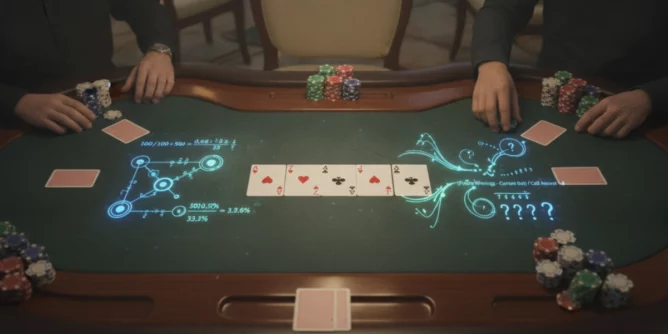
The Math Behind Every Calling Decision in Texas Hold’em
Most poker players understand that calling a bet requires more than gut feel. What separates consistently profitable players from break-even ones is the ability to translate raw numbers — pot size, bet size, hand equity — into a clear, repeatable framework. Pot odds and implied odds are that framework. They don’t guarantee winning hands, but over a large sample, money flows toward the player who uses them correctly.
Pot odds represent the ratio between the current pot size and the cost of a call. If the pot holds $100 and an opponent bets $50, calling costs $50 to win $150 total — pot odds of 3:1, or 25% in percentage terms. That figure is then compared against hand equity: the probability of improving to the best hand by the river. If equity exceeds the pot odds percentage, calling is mathematically justified. If it falls short, folding is correct regardless of how the hand feels.
In Texas Hold’em, this calculation comes up most often on the flop and turn, when drawing hands must evaluate whether chasing is profitable. A flush draw on the flop carries roughly 35% equity to hit by the river, or about 19% to hit on the next street alone. Knowing which figure to use — and when — is where practical application matters more than theory.
Calculating Pot Odds Quickly at the Table
The cleanest method is converting everything to percentages. Divide the call amount by the total pot after calling. In the earlier example: $50 divided by $200 equals 25% — the required equity to break even. More than 25% equity, call. Less, fold.
Common draws map to equity figures worth memorizing:
- Open-ended straight draw (8 outs): approximately 32% to hit by the river, 17% on the next street
- Flush draw (9 outs): approximately 35% to hit by the river, 19% on the next street
- Gutshot straight draw (4 outs): approximately 17% to hit by the river, 9% on the next street
- Two overcards (6 outs): approximately 24% to hit by the river, 13% on the next street
The distinction between “by the river” and “on the next street” matters enormously. Using the full two-street equity figure is only valid when calling all-in. In most non-all-in spots, calculate based on one card — the immediate next street — since the opponent may bet again on the turn, changing the cost structure entirely.
Where Stack Depth Changes Everything
Pure pot odds work cleanly in shallow-stack situations. But in deeper-stacked cash games, the calculation is only half the picture. A call that looks unprofitable on pot odds alone can become correct once implied odds — the potential to win additional chips when the draw completes — enter the equation.
Implied odds aren’t a fixed number. They require reading the opponent, estimating how likely they are to pay off a made hand, and judging whether stack depths make that payoff realistic. A flush draw with $300 behind in a cash game plays very differently than the same draw with $60 behind in a tournament where the next raise could mean elimination.
Quantifying Implied Odds Without Guessing
The common mistake is treating implied odds as a vague justification for calling. In reality, they require the same disciplined estimation as pot odds, applied to money that doesn’t yet exist in the pot. The question isn’t whether implied odds are present — it’s whether they’re large and realistic enough to bridge the gap between current equity and the break-even threshold.
A workable approach is calculating the exact dollar shortfall first. If pot odds require 30% equity but the draw carries only 19% on the next street, there’s an 11-point gap. In a $200 pot with a $75 call, implied odds must cover roughly $145 in future winnings to make the call profitable. If the opponent only has $100 remaining, the math closes the door regardless of the read.
Several factors make implied odds genuinely reliable rather than speculative:
- The draw is disguised — suited connectors completing to a flush are harder for opponents to read than obvious straight draws on paired boards
- The opponent is deep-stacked and has demonstrated willingness to make large bets or calls post-flop
- Position allows seeing the opponent’s action before committing additional chips on the next street
- The completed hand is the nuts or very close to it, eliminating reverse implied odds concerns
That last point carries more weight than most players give it. Reverse implied odds — completing a draw only to lose to a better hand — represent an often-ignored leak. A low flush draw may hit the river and still lose to a higher flush, punishing the player for a call that looked profitable in isolation. Hands with reverse implied odds exposure need a higher equity threshold, not a lower one.
Adjusting Calculations Across Different Bet Sizes
Bet sizing dramatically shifts the pot odds picture. Small bets between 20% and 40% of the pot create odds so favorable that many draws call profitably on math alone, requiring only 15% to 28% equity. At these sizings, implied odds become less urgent — the bet offers enough upfront value that speculative calls with modest equity are justified without future streets doing heavy lifting.
Overbets work in the opposite direction. A 125% pot bet demands roughly 55% equity to call profitably, a threshold most drawing hands cannot meet without extraordinary implied odds. Against overbets, the decision almost always collapses into whether the remaining stack justifies continuing, or whether folding preserves chips for a higher-equity spot. In tournament play, where stack preservation carries strategic value beyond pure chip EV, this calculation weighs even more heavily toward discipline.
Applying the Framework Across Stack Depths
Stack-to-pot ratio — SPR — offers a clean way to integrate stack depth into the framework. A low SPR of 1 to 3 means the pot is large relative to remaining stacks and decisions typically resolve on the current street. Implied odds matter very little because there isn’t enough money behind to move the needle. Pot odds alone drive the decision.
A medium SPR of 4 to 8 is where the interplay between pot odds and implied odds becomes most relevant. There’s enough money behind to make future streets meaningful, but not so much that speculative hands with poor current equity become automatic calls. Reading the opponent’s stack, position, and post-flop tendencies most directly determines whether a marginally unprofitable pot-odds call becomes profitable when future streets are factored in.
At high SPRs of 10 or above — common in deep-stacked cash games or early tournament stages — implied odds take on maximum weight. A flush draw on the flop with 150 big blinds behind in a single-raised pot is an entirely different proposition than the same draw in a three-bet pot where stacks are already 60% committed. The deeper the effective stack, the more future streets can compensate for a present-street equity shortfall — but also the more critical it becomes to assess opponent tendencies with precision rather than optimism.
Turning the Math Into Muscle Memory
These calculations are only useful at the table if they’ve been internalized to the point where they don’t slow decision-making. The goal isn’t to work through long division while an opponent waits — it’s to have core percentages so familiar that the mental process becomes rapid cross-reference rather than calculation from scratch. Equity figures for common draws, pot odds percentages for typical bet sizes, and stack thresholds that make implied odds meaningful should all function as reference points, not problems to solve under pressure.
The most effective way to reach that level is deliberate review away from the table — running through hand histories with explicit pot odds and implied odds calculations, asking not just “was this a good call?” but “what was my exact required equity and what was my realistic equity?” PokerNews Strategy offers worked examples and scenario breakdowns that complement this kind of systematic self-study.
What makes the framework durable across formats, stack depths, and opponent types is that it never demands certainty — only an honest estimate that’s better than the alternative. Pot odds provide a fixed mathematical threshold. Implied odds require disciplined estimation. Together, they replace instinct-driven guesswork with a process that compounds profitably over thousands of decisions, even when individual hands don’t cooperate.
Stack depth sets the stage. Bet sizing sets the price. Equity determines the value. When all three inputs are read accurately and fed into the same framework, calling decisions stop feeling like gambles and start functioning exactly as they should — as calculated investments with a measurable edge.
