
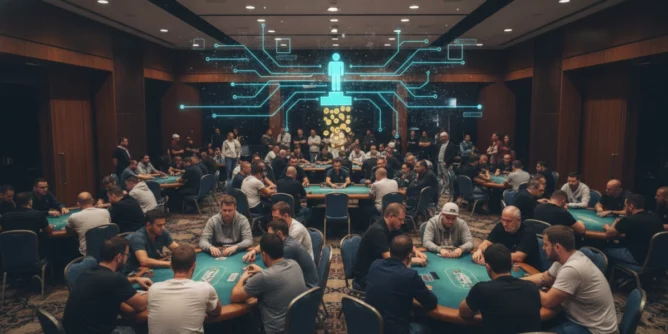
Why Satellite Tournaments Demand a Completely Different Mindset
Most serious players approach every tournament the same way: accumulate chips, apply pressure, build a stack that gives options late. That logic is sound in standard poker turniri where finishing positions translate into increasing prize money. In satellites, it breaks down almost immediately.
A satellite awards a fixed number of seats — entries into a larger, more expensive event — and every player who finishes inside that threshold receives identical value. The player who bags ten times the average stack earns exactly the same prize as the player who scrapes through with two big blinds. That single structural fact rewires every decision at the table.
The difference between treating a satellite like a normal MTT and treating it as the distinct format it actually is can be measured directly in equity lost. Over a sample of entries, that gap becomes significant.
How the Seat-Only Payout Structure Creates Strategic Distortions
In a standard tournament, chip accumulation and expected value move together. In a satellite, chips above what is needed to survive carry zero additional prize equity. Excess chips are essentially worthless beyond their survival function.
This creates the core distortion: situations arise where the correct play is to avoid confrontation entirely, even when a standard MTT player would be reaching for chips. A player sitting on a commanding stack with five players left and four seats available has almost no incentive to play a marginal spot. The risk of busting is real; the reward of winning a coin flip is nothing but cosmetic.
Conversely, short stacks operate under sharper pressure. With no prize money scaled to finishing position, there is no consolation for finishing sixth when only four seats are on offer. Every chip a short stack holds carries survival value — and that changes how aggression, shove ranges, and calling ranges must be calibrated.
The Bubble Dynamics Most Players Consistently Misread
Satellite bubbles are more exploitable than standard MTT bubbles because so many players fail to adjust. The incentive to avoid busting is far stronger here than at almost any comparable moment in a regular event.
Big stacks who recognize this can generate significant fold equity by applying pressure to medium stacks — players who have enough chips to fold into a seat but not enough to comfortably call off their tournament life. These medium stacks are caught between two bad options, and the big stack profits from that tension without showing down a single hand.
This dynamic interacts directly with stack-size thresholds — the specific chip counts at which a player transitions from a comfortable coasting position to dangerous middle ground where every decision carries disproportionate consequence.
Identifying Stack Thresholds and Why They Govern Every Decision
A threshold is the chip count at which a player’s strategic posture fundamentally changes — the point separating a stack that can coast from one that cannot. Recognizing where those lines fall, and which side of them your opponents are on, is the single most useful real-time skill a satellite player can develop.
If a satellite awards four seats and twelve players remain, a rough calculation of the average stack needed to survive gives a baseline. Players comfortably above that number — at one and a half to two times the required survival stack — have strong incentive to fold anything short of a premium hand. They are protecting equity that is nearly certain if they simply stay out of traffic.
Players below that threshold exist in a different universe. They cannot fold their way to safety because the blinds and antes will consume them before the field narrows enough. Their shoving range widens considerably — not recklessly, but because passive play guarantees the outcome they are trying to avoid. Timing aggression to exploit the paralysis of medium stacks caught between these two poles is a repeatable edge that compounds over every satellite entered.
How to Adjust Shoving and Calling Ranges Under Satellite Conditions
Standard push-fold charts, built on chip-EV logic, are dangerously misleading in satellite spots. They were designed for formats where every chip carries marginal prize equity, not formats where survival past a fixed threshold is the only prize that matters.
Shoving ranges near the bubble typically need to widen on the pushing side and narrow — sometimes dramatically — on the calling side. If you shove and everyone folds, you survive and gain blinds. If you call off your stack and lose, you are eliminated with no consolation. That asymmetry favors the aggressor in ways that feel counterintuitive until you examine the underlying equity.
Calling ranges are where even experienced players leak the most satellite equity. Consider a player sitting on twelve big blinds near the bubble, holding a statistical favorite against the shover’s estimated range. In a standard MTT, the call is automatic. In a satellite where that player already holds enough chips to fold into a seat, calling introduces variance that serves no purpose — winning gains nothing in seat terms, and losing ends the tournament.
- Wide shoving ranges generate fold equity from paralyzed medium stacks without requiring confrontation
- Calling ranges should contract sharply once a player’s stack crosses the survival threshold
- Players who are pot-committed by the antes must be distinguished from those gambling unnecessarily
- Recreational players frequently call too wide near satellite bubbles — adjusting your shoving range accordingly is correct
Reading Table Dynamics When Everyone Knows the Seat Count
One underappreciated element of satellite strategy is how transparent the incentive structure becomes as the field shrinks. When eight players remain and five seats are available, everyone at the table can count to the same number and knows what everyone else needs.
This shared transparency changes the psychological texture of the table. The medium stack in seat three is visibly uncomfortable and unlikely to get involved without a monster. Reading who has accepted their situation, who is still in denial about needing to shove, and who is irrationally attached to their chip lead creates informational advantages that extend well beyond card-reading.
Players who have run deep in many satellites develop a specific peripheral awareness — an understanding that action in hands they are not involved in carries information about stack trajectories and approaching moments where a short stack will be forced to move. Positioning yourself to be the aggressor when that moment arrives, rather than the caller, separates consistent satellite winners from players who treat each hand in isolation.
Why Consistent Satellite Winners Think in Equity, Not Chips
Everything above converges on a single discipline: evaluating every decision in terms of seat equity rather than chip accumulation. This is not a minor reframing — it is a fundamental shift in how a player measures success, and it requires active effort to maintain when instincts built in standard tournaments push back hard.
The players who consistently extract value from satellite formats are not necessarily those with the deepest technical knowledge. They are the ones who have genuinely internalized the seat-only payout structure and allowed it to govern behavior at decision points where most players revert to familiar patterns. When the field is one elimination away from the seats, they are not thinking about pot odds in the traditional sense. They are thinking about which action preserves accumulated equity and which introduces variance they do not need.
That discipline extends to pre-tournament preparation. Choosing which satellites to enter, understanding the ratio of seats to total entrants, and identifying formats where recreational players are likely to misplay the bubble are all decisions made before a single hand is dealt. PokerNews covers satellite strategy in useful depth for players looking to extend their preparation beyond the table itself.
The format will always attract players who treat it as a cheaper version of a real tournament. That perception is the edge. As long as the field is populated with players who overvalue chip accumulation, call too wide on the bubble, and shove too tight when survival pressure demands aggression, the player who understands the structure will hold a measurable and repeatable advantage — not hand by hand, but across every satellite they enter. That is precisely what makes the format worth mastering.
