
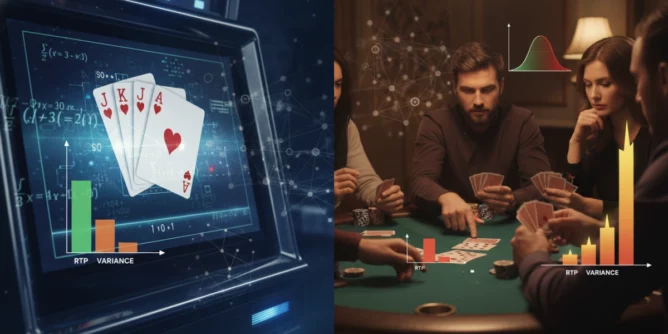
Two Different Games That Share a Name and Almost Nothing Else
Most serious poker players dismiss video poker without much thought. It sits near the slots, runs on a fixed paytable, and doesn’t involve reading anyone. That’s a reasonable first impression — but it misses something. The structural differences between video poker and real poker are precisely what make the comparison worth making. Understanding how one game is built sheds light on how the other works, and why the skills that matter in each are so fundamentally different.
The starting point is mechanical. Video poker is a house-banked game. The player competes against a pay table, not other players. Every decision plays out against a fixed mathematical structure the casino controls. Real poker — whether live or online — is player-versus-player, where the house takes a rake but has no stake in who wins the hand. That single distinction drives almost every meaningful difference between the two formats.
RTP Mechanics: Fixed Returns vs. Player-Determined Outcomes
Video poker is one of the few casino games where theoretical return to player can be calculated precisely and, in some variants with optimal strategy, pushed above 99%. Games like Jacks or Better with a full-pay paytable return close to 99.5% with correct play — figures that are published, verifiable, and consistent over the long run.
This is possible because video poker’s RTP is baked into the paytable and the probabilities of a standard deck. A player who memorizes optimal hold decisions for their specific variant will extract the maximum theoretical return. The skill ceiling is real, but finite — once you’ve mastered the decision tree, there’s nothing left to improve.
Real poker has no equivalent concept. There is no fixed RTP because money flows between players, not from a house. A strong player in a soft game might run at substantial profit over time. A weak player in a tough game faces negative expected value not from a paytable, but from the collective skill of opponents across the table. The rake is typically modest — but the player edge, or lack of it, is what actually determines outcomes.
Variance Profiles: Controlled Swings vs. Human Unpredictability
Variance in video poker is measurable and relatively predictable. Swings are driven by the frequency of high-paying hands — royal flushes, straight flushes — which hit rarely but account for a significant portion of long-run return. Players can model expected variance over a given number of hands with reasonable accuracy, making bankroll planning a tractable problem.
Real poker variance is a different beast. Hand strength is only one source of variance. Player tendencies, table dynamics, stack sizes, position, and decision quality all interact to make short-term results deeply noisy. A winning online player might experience a 50,000-hand downswing through no fault in their strategy. MTT players face even more compressed variance — a single tournament can swing a session’s result by hundreds of buy-ins.
This isn’t a flaw; it’s an inherent feature of a game where skill expresses itself over a large sample. But it means the emotional and bankroll management demands of real poker are categorically different from video poker, where the math is known and variance operates within a more predictable envelope.
How Skill Actually Functions — and Where It Runs Out
In video poker, skill is a closed system. The correct play for any given hand and paytable can be determined mathematically, committed to memory, and executed without deviation. The decision trees for games like Deuces Wild or Double Double Bonus are genuinely complex, and most casual players leave meaningful EV on the table through small errors. But the skill involved is fundamentally about accuracy within a known framework. You’re not adapting to an opponent; you’re aligning decisions with a fixed optimal strategy that already exists.
Real poker skill is open-ended with no ceiling. Exploitative play, range construction, solver-informed frequencies, population reads, live tells, table image, ICM pressure in tournaments — every dimension demands ongoing development. More importantly, the right play in real poker is context-dependent in ways no single strategy tree can resolve. The optimal decision against a passive player in a nine-handed cash game is not the same as against an aggressive regular in a heads-up pot, even on an identical board. That fluidity is where real poker’s skill depth lives, and it never plateaus the way video poker mastery eventually does.
What Video Poker’s Math Can Teach Real Poker Players
Serious engagement with video poker mathematics sharpens habits of mind that transfer directly to real poker study. The discipline required to calculate exact EVs for hold decisions — resisting the intuitively appealing discard in favor of the mathematically superior one — is the same discipline required to work through solver outputs that contradict your instincts at the table. Both demand comfort with numbers that don’t match gut feeling, and practice trusting the math over the narrative your brain constructs around a hand.
Video poker also offers a clean environment for understanding how paytable changes affect long-run returns. Learning to spot a full-pay machine versus a short-pay version trains the eye to recognize how a single payout adjustment shifts expected value. That sensitivity — noticing when a small structural change carries a large mathematical consequence — applies directly to understanding rake structures, ICM edge in tournaments, or the EV implications of stack-to-blind ratios in late tournament stages.
The House Edge Question — and Why Rake Is Not a Paytable
One area where the comparison breaks down entirely is how players conceptualize the house’s take. In video poker, the house edge is embedded in the paytable — fixed, transparent, and identical for every player regardless of ability. A novice and an expert playing the same machine face the same theoretical return; the expert simply gets closer to it through better decisions.
In real poker, the rake is a transaction cost, not a structural reduction baked into outcomes. The implications are significant:
- A sufficiently skilled player can overcome the rake entirely and generate a net positive return — something mathematically impossible against a video poker house edge, regardless of skill.
- Rake sensitivity varies by format. Spin-and-go players, short-handed cash game regulars, and MTT grinders all face different effective rake structures requiring separate analysis.
- Two players at the same table face the same nominal rake but wildly different effective costs, because rake’s impact depends on win rate — a concept with no analog in video poker.
Players who conflate the two tend to think about poker profitability through the wrong lens. Beating the rake is a floor, not a ceiling. In video poker, playing optimally means squeezing as close to the ceiling as the paytable allows. In real poker, the ceiling is determined by opponents, game selection, and the depth of your own skill — all of which are, to varying degrees, within a serious player’s control.
Knowing What Game You’re Actually Playing
The clearest takeaway from this comparison isn’t that one game is superior — it’s that conflating them produces bad thinking in both directions. Players who bring a video poker mindset to real poker look for a fixed correct answer that doesn’t exist against human opponents. Players who bring a real poker mindset to video poker trust reads and intuition over a strategy chart that already has the right answer written on it. Both errors cost money.
In video poker, skill is convergence — closing the gap between your decisions and the provably optimal ones. The game rewards precision and punishes sloppiness, but doesn’t reward creativity, adaptation, or psychological acuity. Master the strategy tree, find the best paytable, manage your bankroll for your variant’s variance profile, and you’ve done everything the game allows. Resources like the Wizard of Odds provide exact optimal strategy charts for virtually every video poker variant, illustrating just how completely the game can be reduced to a solved decision framework — something that will never be true of real poker.
In real poker, skill is expansion — a continuous process of building a wider model of the game, adjusting to new conditions, and finding edges your opponents haven’t located yet. The rake sets a floor you need to clear, but it doesn’t set a ceiling on what’s possible. That openness is simultaneously what makes real poker so demanding and what keeps serious players studying it for decades without exhausting its depth.
Understanding video poker’s mathematical structure — paytable sensitivity, precise EV calculation, variance modeling — trains the analytical habits that real poker study demands. It’s a clean laboratory for building comfort with uncomfortable math. But it’s a laboratory, not a substitute. The moment human opponents enter the equation, the game changes in kind, not just in degree. Knowing which game you’re sitting down to play, and thinking clearly about what skill actually buys you in that context, is where serious study of either format has to begin.
